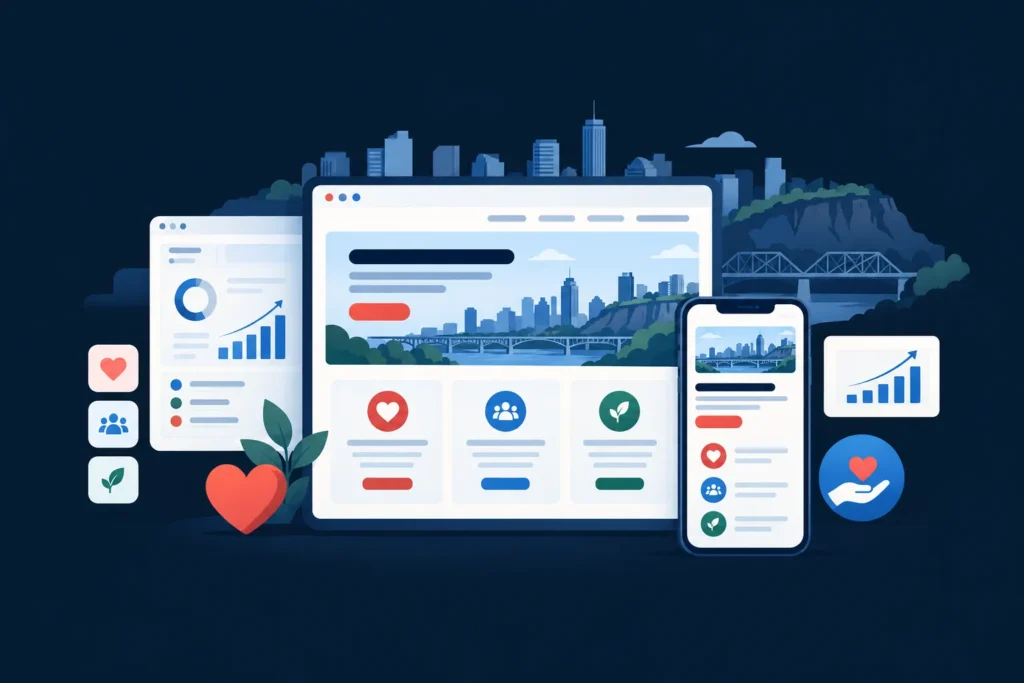
For a Hamilton nonprofit, your website has one job above all: help the right people take the next step. That may mean making a donation, registering for a program, volunteering, attending an event, requesting support or sharing your mission with someone who can help.
Effective nonprofit web design in Hamilton combines a clear mission, accessible information, credible storytelling and simple conversion paths. It should serve people across Hamilton, including residents searching for local services, volunteers looking for meaningful opportunities and donors deciding whether your organization is trustworthy.
A strong nonprofit website is not simply an online brochure. It is a practical community tool that works on mobile devices, answers urgent questions quickly and makes it easy for supporters to contribute.
What a Hamilton nonprofit website should accomplish
Your website should help different audiences find the information they need without making them understand your internal structure first. A donor may want financial and governance information. A client may need program eligibility and contact details. A volunteer may be looking for available shifts. A community partner may want to understand your impact.
The most effective nonprofit website design gives each audience a clear route from the homepage to the next action. That usually means:
- A plain-language explanation of who you help and how you help them.
- Prominent donation, volunteer and contact actions.
- Easy-to-find program information, eligibility details and service areas.
- Trust signals such as leadership information, reports, partnerships and real community stories.
- Fast, accessible performance on phones and slower connections.
- Content structured so search engines and AI-powered search tools can understand your organization.
For a Hamilton organization, local context matters. Visitors may be searching for support in specific neighbourhoods, asking whether you serve the broader Hamilton area or looking for help near a familiar community location. Your website should answer those questions directly rather than relying on vague statements about serving the community.
A conversion-focused website structure for Hamilton nonprofits
A practical website structure reduces confusion and supports both fundraising and community access. The exact navigation will depend on your organization, but the following page framework works well for many Hamilton nonprofits.
Homepage
The homepage should communicate your purpose within seconds. A useful opening section can answer three questions:
- Who does your organization serve?
- What problem or need do you address?
- What should the visitor do next?
Use a concise headline, a supporting explanation and two or three visible calls to action. For example, a community organization might prioritize “Get support,” “Donate” and “Volunteer.” Avoid presenting every possible action with equal visual weight. Too many competing buttons can make the page less effective.
Programs and services
Give each major program its own page when people may search for it separately or need detailed information before contacting you. Include eligibility, availability, cost, location, registration steps, accessibility information and a clear contact option.
Write for the person who needs help, not for staff members who already understand nonprofit terminology. Explain acronyms and replace internal program language with direct descriptions.
Donate
The donation page should be focused and reassuring. Explain what donations support, show the available giving options and provide a secure, mobile-friendly donation process. If you accept monthly donations, make that option easy to understand without hiding one-time giving.
Include practical details such as tax receipt information, accepted payment methods and who donors can contact with questions. Do not force visitors to search through several pages to find the organization’s charitable registration or donation policies when those details are important to their decision.
Volunteer
A volunteer page should explain the available roles, expected time commitment, screening or training requirements and what happens after someone submits an application. A short form is usually more effective than asking for an extensive application before a visitor understands the opportunity.
About, impact and transparency
People want to know that an organization is responsible, active and connected to the community it serves. Use your About and Impact pages to explain your history, leadership, partnerships, outcomes and current priorities.
Where appropriate, publish annual reports, financial information, policies and board details. These materials support donor confidence and help prospective partners evaluate your organization.
Contact and location
Make it easy to call, email or visit. Include hours, service boundaries, transit or parking information where useful, and instructions for urgent versus non-urgent requests. If your organization serves several Hamilton neighbourhoods or operates from multiple sites, explain that clearly.
The Hamilton Nonprofit Action Pathway
One original framework we use when planning nonprofit websites is the Hamilton Nonprofit Action Pathway. Every important page should move a visitor through five questions:
- Recognition: Is this organization relevant to my need or values?
- Reassurance: Does the organization appear trustworthy and capable?
- Relevance: Do I understand the program, opportunity or impact?
- Response: Can I complete the next action without unnecessary effort?
- Return: Is there a reason and an easy way to stay connected?
For example, a volunteer landing page could introduce the cause, show a short story from a volunteer, explain current roles, link to a simple application and offer an email newsletter or event calendar. This framework helps prevent attractive pages from becoming dead ends.
Donation and volunteer conversion ideas
Good conversion design does not pressure people. It removes uncertainty and makes a meaningful action feel straightforward.
- Use one primary call to action in the header, supported by secondary actions in the page content.
- Repeat important calls to action after visitors have had a chance to understand the organization.
- Use descriptive button labels such as “Donate monthly,” “Apply to volunteer” or “Find program information.”
- Show what happens after a form is submitted, including expected response times where you can maintain them.
- Keep forms short and ask only for information that is necessary at that stage.
- Use confirmation pages to provide next steps, social sharing options or related resources.
- Make phone numbers and email addresses easy to use on mobile devices.
Track useful actions such as completed donations, volunteer applications, contact form submissions, newsletter signups and event registrations. Measurement should help your team improve the experience, not simply produce a large collection of analytics reports.
Trust signals that matter to donors and community members
Trust is especially important when visitors are deciding whether to give money, share personal information or ask for help. A polished design cannot replace evidence of responsible work.
Consider including:
- Specific descriptions of programs and the communities they serve.
- Current leadership and staff information.
- Annual reports, financial documents and governance information.
- Relevant community partnerships and funding relationships.
- Authentic stories, with consent and appropriate privacy safeguards.
- Clear donation processing and tax receipt information.
- Updated contact details and visible organizational ownership.
Use real photography when possible, but treat images respectfully. Do not use identifiable images of clients without appropriate consent, and do not present people only as symbols of need. A responsible visual system can show dignity, participation, staff expertise and community connection.
Mobile UX and accessibility for nonprofit websites
Many visitors will discover a nonprofit while away from a computer. They may be using a phone to find a service, make a donation or contact an organization quickly. Mobile design should therefore be planned from the beginning rather than treated as a final adjustment.
Important considerations include:
- Readable text with comfortable spacing and strong colour contrast.
- Buttons and form fields large enough to use accurately on a phone.
- Compressed images and efficient page loading.
- Headings that create a logical content hierarchy.
- Alt text for meaningful images and empty alt attributes for decorative images.
- Captions or transcripts for important video and audio content.
- Keyboard-friendly navigation and visible focus states.
- Plain language for people with different literacy, language and cognitive needs.
Accessibility is not just a technical feature. For organizations serving Hamilton residents, it is part of providing equitable access to information and services. Your website team should review the experience with real users and address barriers that automated tools may miss.
Local SEO for Hamilton nonprofits
Local SEO helps people discover your organization when they search for services, causes or volunteer opportunities in Hamilton. Start with accurate, consistent information about your organization’s name, address, phone number, service area and hours.
Each important program should have useful page content rather than being represented only by a list of links. Mention Hamilton naturally when it clarifies your service area, and include relevant neighbourhood or regional details when they are genuinely useful. Avoid creating thin pages for every neighbourhood if the information is substantially the same.
Other practical steps include:
- Claiming and maintaining the appropriate Google Business Profile.
- Using descriptive page titles and meta descriptions.
- Adding clear organization and location information.
- Publishing helpful answers to common service and eligibility questions.
- Keeping event, program and contact information current.
- Building legitimate relationships with Hamilton partners and community organizations.
For a broader local search strategy, see our Hamilton SEO services. SEO should support accurate discovery and useful information, not promise rankings that no agency can guarantee.
Content that works for search and AI answers
Search engines and AI assistants are more likely to understand your organization when your content is specific, well organized and consistent. Write direct answers to questions such as who you serve, where programs operate, what eligibility means, how to donate and how to volunteer.
Use descriptive headings, short paragraphs and lists where they improve scanning. Keep program pages updated and include an identifiable organization name, contact information and publication or update dates when appropriate. Make sure important information appears in the page text rather than only inside images, PDFs or social media feeds.
This approach also improves the experience for people who arrive through a search result without first visiting your homepage.
Choosing a Hamilton nonprofit web designer
When evaluating a Hamilton web designer, ask how they will connect design decisions to your organization’s actual goals. A suitable partner should be able to discuss information architecture, donation workflows, accessibility, content ownership, analytics, security, ongoing maintenance and local search.
Ask to see relevant work in the WebDesignGTA.com portfolio, and ask how the team handles content migration, staff training and future updates. A nonprofit website should not become difficult or expensive to manage every time your programs change.
If you are comparing broader service options, our Hamilton web design service explains how a strategy-led website can support local organizations and businesses without relying on generic templates.
A practical nonprofit website checklist
- The mission and audience are clear on the homepage.
- Donation, volunteer and contact actions are easy to find.
- Program pages explain eligibility, location and next steps.
- Important information is accurate and recently reviewed.
- The website works well on phones and supports accessible use.
- Donation and contact forms are simple and reassuring.
- Trust information is visible and easy to verify.
- Hamilton service-area details are specific and consistent.
- Analytics measure meaningful actions and not only page views.
- Staff know how to update key content after launch.
Plan a better nonprofit website for Hamilton
Your organization does not need the largest website or the most complicated technology. It needs a clear digital experience that helps people understand your work, trust your organization and take the right next step.
WebDesignGTA.com can help you plan a nonprofit website around donations, volunteers, programs and community reach. Contact us for a tailored website plan or quote, or start by exploring the WebDesignGTA.com homepage to see how we approach strategy, design and local visibility.