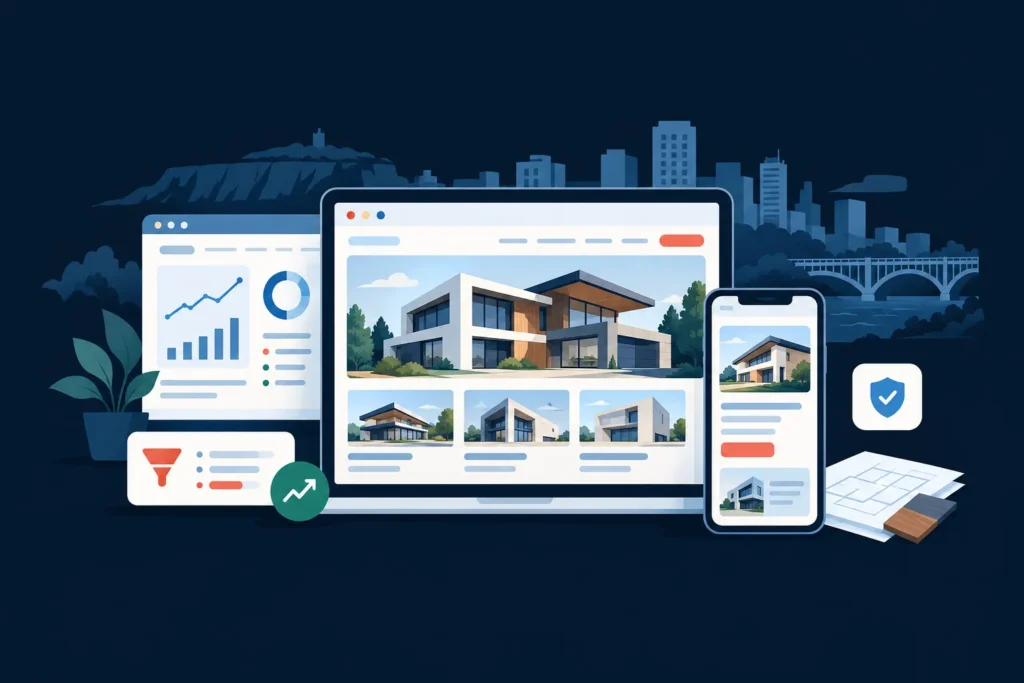
For an architecture practice in Hamilton, a website should do more than display attractive images. It should help the right prospective client understand your expertise, see relevant evidence of your work, and take the next step with confidence.
Effective architect web design in Hamilton combines a strong project portfolio with clear services, local search visibility, mobile usability, and a straightforward enquiry process. The goal is not simply to generate more traffic. It is to turn suitable visitors into better-informed enquiries for residential, commercial, renovation, heritage, or development projects.
If your current website makes visitors search for your services, hides project details, or relies on a generic contact form, a redesign may improve both the quality of your first conversations and the way your practice is perceived.
What an architecture website needs to achieve
People looking for an architect are usually making a significant decision. They may be comparing practices for a custom home, addition, commercial property, adaptive reuse project, or planning application. Before contacting you, they want answers to practical and visual questions:
- Does this practice handle projects like mine?
- Does its design approach match my priorities?
- Does it work in Hamilton and the surrounding area?
- Can it explain the process clearly?
- Does its portfolio show completed, credible work?
- Will the initial conversation be useful and professional?
Your website should answer these questions without making visitors piece information together. A strong architecture website presents your work in context, explains your role, sets expectations, and provides a clear path to contact you.
A high-converting website structure for Hamilton architects
There is no single page structure for every practice, but the following architecture website design framework works well for firms that want to attract qualified local enquiries.
Home page: position the practice quickly
The first screen should communicate three essentials: what you do, where you work, and why a visitor should continue exploring. A statement such as “Architecture and thoughtful renovation design for homes and commercial spaces in Hamilton” is more useful than a vague slogan about shaping the future.
Follow the opening section with selected projects, primary services, a short explanation of your process, and a prominent enquiry route. Visitors should be able to reach the portfolio, services, and contact page without scrolling through a long introduction.
Projects: turn images into persuasive evidence
A grid of attractive photographs is not enough. Each project should have its own page where possible, with useful information such as:
- Project type and general location
- Scope of services provided
- Design objectives and constraints
- Relevant planning, heritage, site, or construction considerations
- Key design decisions
- Completed photography, drawings, or carefully labelled visualisations
- Project status, where a project is ongoing or not yet completed
For Hamilton searches, project context can be particularly valuable. A visitor may want to see how your practice approaches an older home, a constrained urban lot, a contemporary addition, a rural property near the city, or a commercial conversion. You do not need to reveal a client’s private address. General location and project context are often enough to demonstrate relevant experience.
Services: make the scope easy to understand
Use dedicated sections for the services you actually provide. Depending on your practice, these may include feasibility studies, concept design, design development, permit drawings, tender support, contract administration, construction documentation, interior architecture, or project consultation.
A useful service page explains who the service is for, when it enters the project, what the client receives, and what happens next. Avoid presenting a long list of technical terms without explaining their practical value.
About: build confidence without writing a biography
Prospective clients want to know who they will work with and how the practice operates. Include credentials, areas of expertise, professional memberships where relevant, design philosophy, and the types of clients or projects you typically serve.
Professional photography of the team can help, but the page should remain focused on client confidence. Explain how communication, decision-making, and collaboration work in practice.
Contact: reduce uncertainty at the point of conversion
A contact page should make the first step feel easy. Explain what information is helpful, whether you offer an initial consultation, what areas you serve, and how quickly people can generally expect a response. Avoid promising a response time unless your practice can consistently meet it.
A useful enquiry form may ask for the project type, approximate location, current stage, expected timeline, and a short description of the goals. Keep the form proportionate. Asking for too much information before a first conversation can discourage good prospects.
The Project-to-Proof framework for architecture portfolios
One original way to strengthen an architect website is to treat every portfolio project as a Project-to-Proof page. Instead of showing only the finished result, connect four elements:
- Brief: What did the client need to achieve?
- Constraint: What site, budget, planning, heritage, material, or functional issue shaped the work?
- Response: What design decisions did your practice make?
- Proof: What drawings, photographs, material details, approvals, or completed spaces demonstrate the result?
This framework gives search engines more meaningful content to understand and gives human visitors a better basis for judging your expertise. It also helps a potential client recognise similarities between your past work and their own situation.
For example, a Hamilton renovation project could explain how the design connected an older portion of the home with a new addition, improved circulation and daylight, and responded to the property’s context. The page should describe only verified project details and should never imply outcomes that cannot be supported.
Mobile user experience matters for visual practices
Portfolio-heavy websites often look impressive on a large screen but become difficult to use on a phone. Prospective clients may discover your practice through a local search, referral, social post, or shared project link on a mobile device.
Check that your website:
- Loads key project images efficiently without sacrificing appropriate quality
- Uses readable text and comfortable spacing
- Provides clear navigation on smaller screens
- Places contact options where they are easy to find
- Uses captions and descriptive alternative text for meaningful images
- Does not rely on hover effects or tiny controls
- Allows project pages to open and scroll smoothly
Mobile design is not about shrinking a desktop layout. It is about prioritising the information a visitor needs at each stage. Project images should support the story rather than delay the page from loading, and navigation should make it simple to move from a project to a relevant service or enquiry page.
Local SEO for architects in Hamilton
Local SEO helps your practice appear when people search for relevant services in Hamilton and nearby communities. It cannot guarantee a specific position, but it can make your business easier for search engines and prospective clients to understand.
Start with accurate, consistent business information across your website and relevant business profiles. Your practice name, service area, contact details, and category should be clear. If you maintain a Google Business Profile, keep its information current and direct visitors to the most relevant page rather than only to the home page.
On your website, use natural language such as architectural services in Hamilton, residential architecture in Hamilton, or commercial design for Hamilton properties where those phrases accurately describe your work. Do not repeat “architect web design Hamilton” unnaturally throughout the page. Search visibility is stronger when the content clearly explains your services, projects, expertise, and location.
Helpful local signals can include:
- Dedicated service pages that mention the communities you genuinely serve
- Detailed project pages with accurate general location information
- A clear contact page with your service area
- Consistent business details across reputable profiles
- Relevant local partnerships, professional associations, or project references
- Descriptive page titles and headings that match the page content
For broader support, review WebDesignGTA’s Hamilton SEO services and consider how technical improvements, content structure, and local relevance can work together.
Trust signals that matter to architecture clients
Architecture is a high-consideration service, so trust should be built throughout the site rather than placed on one testimonials page. Useful trust signals include:
- Professional credentials and relevant experience
- Clear descriptions of your role on past projects
- Real project photography and properly labelled visualisations
- Client testimonials used with permission
- Project types that match the work you want to win
- Transparent explanations of your process
- A professional email address and accessible contact details
- Secure, technically maintained website functionality
Do not manufacture reviews, inflate project results, or describe concept images as completed work. Accurate presentation protects your reputation and gives prospective clients a more reliable basis for choosing your practice.
Common architect website problems in Hamilton
Many architecture websites lose potential enquiries for reasons that have little to do with the quality of the practice itself.
The portfolio is beautiful but unexplained
Visitors cannot tell what the firm was responsible for, what type of project they are viewing, or whether the work is relevant to their needs. Add concise project narratives and clear service information.
The website speaks to peers instead of clients
Technical language has its place, but clients also need plain explanations. Describe how your work helps them make decisions, manage complexity, and move from an idea toward an achievable project.
Every project is shown at the same level of priority
A large undifferentiated gallery can make it difficult to understand your strongest areas. Feature the projects most aligned with your preferred work and group the remainder by type or service.
The contact process is vague
A “Contact” button without context creates unnecessary hesitation. Explain what happens after an enquiry and what information will help you assess the opportunity.
The site is difficult to update
Architecture practices evolve. A manageable content system makes it easier to add completed projects, update team information, publish useful insights, and keep service pages accurate.
Choosing a Hamilton architects website designer
When comparing an agency or freelancer, ask how they will turn your project information into a useful website structure. A good partner should discuss content, photography, mobile experience, search visibility, lead quality, accessibility, analytics, hosting, and ongoing maintenance—not just colours and animations.
Review the provider’s website design portfolio and ask how the proposed site will support your preferred project types. You can also explore the broader Hamilton web design service to understand the local business approach.
For a practice that serves clients across Hamilton, Burlington, Ancaster, Dundas, Stoney Creek, and nearby areas, the final site should balance local relevance with a polished professional presence. It should not read like a generic small-business template with a city name inserted into the copy.
Plan a website that supports better enquiries
The best architect website design is not the one with the most effects or the largest image files. It is the one that helps a suitable visitor quickly understand your work, see proof of relevant expertise, and feel comfortable starting a conversation.
WebDesignGTA can help you plan an architecture website around your projects, services, preferred clients, and Hamilton search visibility. Visit the WebDesignGTA home page to learn more, or request a tailored website plan or quote for your practice.