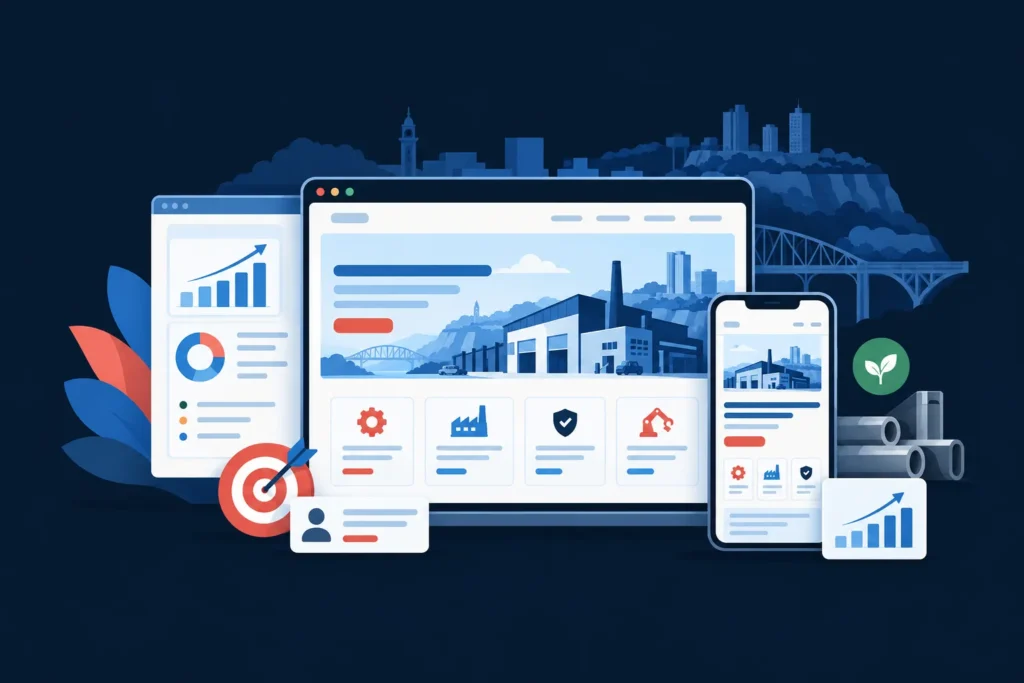
For a Hamilton manufacturer, a modern website should do more than display equipment, capabilities and a phone number. It should help a potential buyer understand what you make, confirm that you are a credible supplier, find the right contact, and take the next step without friction.
Hamilton manufacturer web design works best when the website is built around the buyer’s purchasing process. That means clear capabilities, useful technical information, strong proof, local search visibility and conversion paths for visitors who may be researching a supplier before they are ready to speak with sales.
Whether your company operates in Hamilton, Ancaster, Stoney Creek, Dundas or the surrounding industrial corridor, your website can support sales conversations with Ontario businesses and customers across Canada, the United States and international markets.
Why manufacturing websites need a different strategy
A manufacturing website is not simply a brochure. Its visitors may include procurement managers, engineers, plant managers, general contractors, product developers and existing customers looking for documentation.
These visitors often want answers to specific questions:
- What does the company manufacture or process?
- Can it handle the required materials, dimensions, tolerances or production volumes?
- Does it serve the right industry?
- Where is the facility located, and which markets does it serve?
- Can the team provide engineering support, prototyping, finishing, assembly or logistics?
- How quickly can someone respond to a drawing, specification or quote request?
If the answers are difficult to find, a prospective buyer may move to another supplier. Effective manufacturing website design makes technical information easier to navigate while keeping the next commercial step visible.
A high-performing website structure for a Hamilton manufacturer
The right structure depends on your capabilities and sales process, but most industrial companies benefit from a website architecture that separates broad company information from specific commercial services.
Recommended primary navigation
- Capabilities: describe each major process, service or production capability on its own page.
- Industries served: explain how your work supports sectors such as automotive, food processing, construction, energy, aerospace or industrial equipment, where relevant.
- Products or solutions: organise manufactured products, components or systems around buyer needs.
- Quality and certifications: present standards, inspection processes, certifications and documentation clearly.
- Projects or case studies: show the type of problem solved, the work completed and the result without disclosing confidential information.
- Resources: include brochures, technical documents, FAQs, drawings, maintenance information and helpful articles.
- About: communicate experience, facility information, team expertise and operating principles.
- Contact or request a quote: provide a direct path for RFQs, technical questions and general enquiries.
Important pages should not be buried under a vague “Services” menu. A page titled “CNC Machining” or “Custom Sheet Metal Fabrication” gives visitors and search engines more useful context than a generic label.
The F.A.C.T. framework for manufacturing website design
A practical way to evaluate a manufacturer’s website is the F.A.C.T. framework: Fit, Assurance, Clarity and Transition.
1. Fit
Within a few seconds, the homepage should make it clear what you manufacture, who you serve and where you operate. “Advanced manufacturing solutions” is not enough on its own. A stronger message identifies the specific capability, customer type or application.
For example, a manufacturer might position itself around precision components for industrial equipment, custom fabrication for construction projects or contract production for OEMs. The wording should reflect the company’s actual strengths rather than broad claims that could describe any supplier.
2. Assurance
Buyers need evidence. Include relevant certifications, quality procedures, years in operation, facility photographs, equipment details, industries served and project examples. If you work with confidential clients, describe the application and scope without revealing protected information.
Useful proof can include:
- ISO or other verified certifications
- Inspection and quality-control procedures
- Material and process information
- Equipment lists with meaningful specifications
- Shipping and service-area details
- Professional memberships and supplier qualifications
- Named contacts for sales or engineering enquiries
3. Clarity
Technical buyers appreciate detail, but detail must be organised. Use headings, diagrams, bullet points, downloadable documents and short explanations before presenting dense specifications. Every capability page should explain what the process is, what it is suitable for, the materials or specifications supported, and how to request a quote.
4. Transition
Every important page should lead naturally to the next action. That may be uploading a drawing, requesting pricing, speaking with an engineer, booking a site visit or contacting the sales team.
Use specific calls to action such as Request a manufacturing quote, Send your drawings or Discuss your production requirements. A generic “Learn More” button is less useful when a visitor is ready to start a commercial conversation.
Conversion features that support B2B lead generation
Manufacturing purchases can involve long sales cycles and multiple stakeholders. Your website should support both immediate enquiries and early-stage research.
Build a better request-a-quote form
A quote form should collect enough information to begin a useful conversation without becoming an obstacle. Consider fields for:
- Company name and contact details
- Project or product description
- Required quantity or expected production volume
- Material, finish or relevant specifications
- Required delivery timeline
- Uploadable drawings, PDFs or reference files
- Preferred method of contact
Explain what happens after submission. For example, tell the visitor whether a sales representative or technical team member will review the request and what information may be needed next. Only request information your team will actually use.
Use multiple conversion paths
Not every visitor is ready to request a quote. Include secondary options such as downloading a capabilities brochure, viewing a project example, asking a technical question or calling the Hamilton facility. On mobile devices, a visible tap-to-call option can be especially helpful for returning customers and time-sensitive enquiries.
Make technical resources easy to find
Product sheets and certifications should not be hidden in an unstructured downloads folder. Give each resource a descriptive title and place it on the relevant capability or product page. This improves usability and gives search engines more context about the subjects your company covers.
Local SEO considerations for Hamilton manufacturers
Local SEO for a manufacturer is not limited to attracting people who want to visit a storefront. It can help buyers identify a legitimate supplier in Hamilton and understand the area, markets and services your company covers.
Start with accurate, consistent business information across your website and relevant business profiles. Your contact page should identify the facility location, service area, phone number, hours and appropriate directions. Do not publish a residential or restricted address simply to create a local signal.
Build useful local relevance through genuine information, including:
- A clear Hamilton location and service-area description
- References to relevant nearby markets, such as the Greater Toronto and Hamilton Area, Niagara or Southwestern Ontario, when those areas are genuinely served
- Project pages that explain the customer’s industry and geographic context where permission allows
- Local partnerships, associations and community involvement that can be verified
- Unique capability pages written for real services rather than duplicated city pages
Keep your Google Business Profile accurate and ensure the website, directory listings and social profiles do not conflict. Add appropriate structured data with accurate business details, but do not expect markup alone to improve rankings. Helpful content, technical accessibility, reputation and a strong user experience all matter.
For a broader local search strategy, see the Hamilton SEO service. Website design and SEO should be planned together so that important commercial pages are both discoverable and useful.
Mobile UX matters in industrial sales
Many manufacturing websites are reviewed on a phone between meetings, from a job site or while someone is travelling between facilities. A mobile visitor should be able to identify your main capabilities, call the team, open the address and submit a basic enquiry without excessive scrolling or pinching.
Check that:
- Navigation labels are easy to understand and tap.
- Phone numbers are clickable.
- Forms work properly on small screens.
- Large industrial photographs are compressed without losing useful detail.
- PDF links identify the document and file size where practical.
- Text has sufficient contrast and comfortable spacing.
- Important calls to action are not hidden below oversized banners.
Mobile performance is also part of professional credibility. A slow website can make a technically capable company appear less prepared, particularly when competitors provide a faster, clearer experience.
How to use photography and proof effectively
Manufacturing websites often rely on generic factory stock photography. Original images are usually more persuasive because they show the actual facility, equipment, people and quality of work.
Useful photography can include machinery in operation, inspection equipment, material handling, finished components, team members and facility details. Add captions where they provide real context. A photograph of a machine is more valuable when the page explains the type of work it supports.
Case studies should be specific without making unsupported claims. A strong format is:
- Requirement: what the customer needed.
- Approach: what your team supplied or changed.
- Considerations: materials, tolerances, volume, timing or compliance requirements.
- Outcome: the verified result, stated without exaggeration.
Do not publish customer names, project figures or performance improvements without permission and documentation. Trust is strengthened by accurate detail, not by inflated promises.
Common website mistakes that cost manufacturers enquiries
- Unclear positioning: visitors cannot tell whether you are a job shop, OEM supplier, distributor or contract manufacturer.
- One generic capabilities page: every process is compressed into a few paragraphs with no useful detail.
- Outdated information: old equipment, former certifications or inactive contacts remain online.
- Weak quote process: the only call to action is a generic contact form with no file upload or project context.
- Limited proof: the website makes quality claims without showing certifications, processes or examples.
- Duplicate location pages: near-identical pages are created for Hamilton, Burlington, Toronto and other cities without unique value.
- Desktop-first design: technical documents, menus and forms are difficult to use on mobile.
Planning a website modernization project
Before requesting proposals, gather your current service list, equipment information, certifications, photography, brochures, analytics access and examples of common sales questions. Ask your sales and production teams which pages prospects request most often and which information is repeatedly explained by email.
Then prioritise the pages closest to revenue: core capabilities, major product categories, industries served, quality information and the quote process. A phased launch can work well when a company has a large catalogue, provided the first release has a complete and useful structure.
You can review examples of our approach on the WebDesignGTA portfolio and learn more about broader Hamilton website design services. The right solution should reflect your production model, sales cycle and internal ability to maintain content.
Frequently asked questions
What should a Hamilton manufacturer include on its homepage?
The homepage should clearly state what the company manufactures, who it serves, where it operates and what visitors can do next. It should link to priority capabilities, quality proof, project examples and a visible quote or contact path.
Should a manufacturing company create a page for every process?
Create separate pages when a process is commercially important, has distinct search intent or requires different technical information. Avoid thin pages that only change a heading or location name. Each page should provide genuinely useful details and a relevant conversion path.
Can a new website help generate more RFQs?
A better website can make qualified enquiries easier by clarifying capabilities, reducing uncertainty and improving the quote process. It cannot guarantee a particular number of leads or search position. Results depend on market demand, offer quality, competition, reputation, content and follow-up speed.
How often should a manufacturer update its website?
Review core information whenever equipment, certifications, capabilities, personnel or service areas change. At least annually, check forms, phone numbers, downloads, project examples, security updates and analytics. Add useful content when recurring customer questions reveal a need.
Build a website that supports your Hamilton sales team
Your website should make it easier for the right buyer to understand your capabilities and start a practical conversation. For a Hamilton manufacturer, that means combining clear positioning, technical depth, credible proof, local relevance, mobile usability and a quote process designed around real B2B enquiries.
Contact WebDesignGTA for a tailored website plan or quote for your manufacturing business. We can help map the right pages, content priorities and conversion opportunities for your facility and sales process.