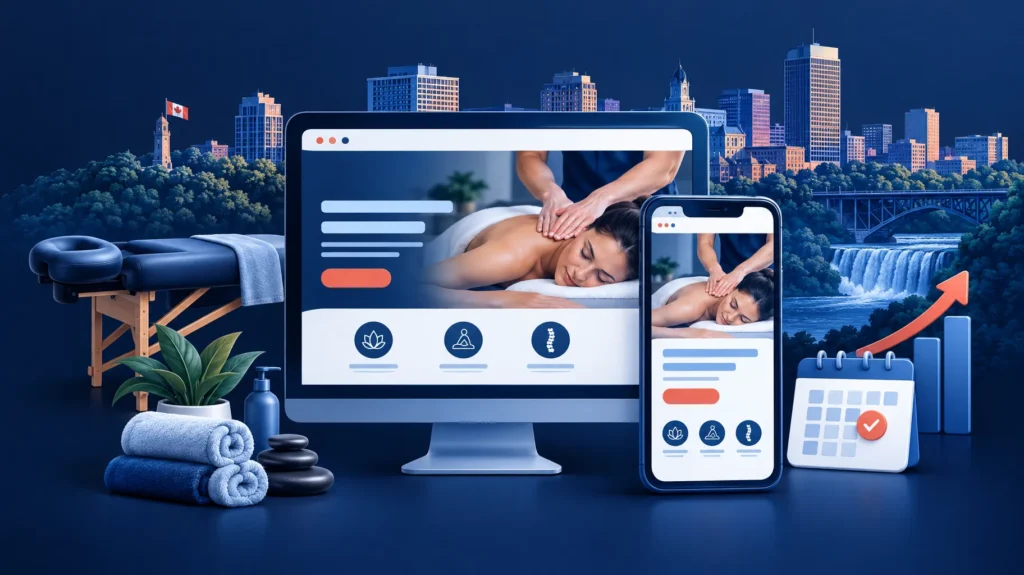
For a Hamilton massage therapy or RMT clinic, a website should do more than explain your services. It should help a potential patient decide that your clinic is trustworthy, understand whether you can help, and book an appointment without unnecessary friction. That is the purpose of effective massage therapy web design in Hamilton.
A high-performing clinic website typically combines clear service information, practitioner credibility, mobile-friendly booking, local SEO, accessible design, and prominent calls to action. It should work for patients searching from Hamilton Mountain, Ancaster, Dundas, Stoney Creek, Waterdown, Binbrook, and nearby areas without sounding like a page created by replacing a city name.
This guide explains the structure a Hamilton RMT website needs, how patients use it before booking, and how WebDesignGTA.com can help build a website and local marketing foundation around your clinic.
How Hamilton patients choose a massage therapy clinic online
Most prospective patients are not comparing website aesthetics in isolation. They are trying to answer practical questions quickly:
- Does this clinic offer the treatment I need?
- Is the clinic conveniently located?
- Can I book online or speak with someone promptly?
- Does the practitioner appear qualified and experienced?
- What should I expect during an appointment?
- Does the clinic look professional, private, and safe?
Someone searching for an RMT in Hamilton may be looking for help with sports recovery, workplace tension, chronic discomfort, prenatal massage, mobility concerns, or general wellness. Your website should make those pathways obvious instead of forcing every visitor through the same generic “Services” page.
The strongest Hamilton website design service plans the visitor journey before selecting colours, fonts, or photography. Each important page should answer a patient question and provide a logical next action, such as booking online, calling the clinic, or requesting more information.
What should a massage therapy website homepage include?
The homepage should communicate your clinic’s location, treatment focus, credibility, and booking option within the first screen on both desktop and mobile. It should not make visitors search through a slider or a long introduction to find out what you do.
Original RMT clinic homepage wireframe
- Header: Clinic logo, primary navigation, phone number, and a visible “Book an Appointment” button.
- Hero section: A specific value proposition, such as registered massage therapy for pain relief, recovery, and mobility in Hamilton, supported by a booking button.
- Trust strip: RMT credentials, direct billing information if offered, appointment availability details, or other accurate trust signals.
- Common treatment paths: Short introductions to services such as therapeutic massage, sports massage, prenatal massage, or treatment for particular concerns.
- How treatment works: A simple explanation of assessment, treatment planning, and follow-up.
- Practitioner introduction: Professional headshots, qualifications, areas of focus, and a link to full bios.
- Reviews: Genuine patient feedback displayed with appropriate attribution and permission where required.
- Location section: Address, service area, parking or transit details, hours, and a map link.
- Final booking prompt: A clear next step for visitors who have reached the bottom of the page.
This structure gives first-time visitors enough information to take action while creating clear pathways for people who need more detail. It also gives search engines a better understanding of the clinic, its services, and its Hamilton location.
Build dedicated pages for services, conditions, and practitioners
A single services page is rarely enough for a clinic with multiple treatment types or patient needs. Dedicated pages allow you to explain each service in plain language and connect it to a relevant booking action.
Service pages
A service page might cover therapeutic massage, deep tissue massage, sports massage, prenatal massage, relaxation massage, or another treatment your clinic actually provides. Each page should explain who the service may be suitable for, what an appointment involves, what patients should know before arriving, and how to book.
Avoid making clinical promises that cannot be supported. Use careful, patient-friendly language and ensure treatment descriptions reflect your professional scope and current practice.
Condition or concern pages
Patients often search by concern rather than treatment name. Depending on your services, useful pages may address neck and shoulder tension, back discomfort, workplace strain, athletic recovery, headaches, or mobility support. These pages should provide helpful educational information without presenting massage therapy as a guaranteed cure or replacing medical advice.
Practitioner pages
Practitioner bios are important conversion pages for healthcare and wellness websites. Include registration details, education, areas of interest, treatment approach, languages spoken if relevant, and a professional photograph. A warm but specific biography can help a new patient decide whether your clinic is a suitable fit.
Healthcare-related website content should be accurate, current, and clear about the difference between general information and individual clinical advice. Your internal review process should include checking credentials, services, hours, pricing, and treatment descriptions regularly.
Make online booking and mobile conversion paths effortless
Many prospective patients will first visit your website on a phone. A mobile visitor should be able to understand your clinic, find the location, call the office, or start booking without pinching, scrolling through oversized graphics, or opening several menus.
Original booking flow for a Hamilton RMT website
- The visitor lands on a service or homepage section that matches their need.
- The page explains the treatment and identifies an appropriate practitioner or appointment type.
- The visitor selects “Book an Appointment” from a persistent header or prominent page button.
- The booking system displays appointment types, practitioner options, and available times clearly.
- The visitor receives confirmation and practical preparation information.
Keep alternative conversion paths visible. Some patients will prefer calling, while others may need to ask about direct billing, treatment suitability, accessibility, or appointment timing before booking. Include a phone number that is clickable on mobile and a short contact form for appropriate enquiries.
The booking platform should be easy to use, but the website still needs to explain what each appointment type means. Sending visitors to an unfamiliar booking screen without context can create uncertainty and abandonment.
Use reviews, bios, and credibility signals responsibly
Trust is especially important when a visitor is considering a healthcare or wellness appointment. Reviews can help, but they should support rather than replace useful information.
- Display genuine reviews and do not edit them in a misleading way.
- Make it clear where reviews originated when appropriate.
- Show current practitioner qualifications and registration information.
- Use real clinic photography or professional images that reflect the experience accurately.
- Explain booking policies, cancellation terms, payment methods, and direct billing details.
- Include a complete address and consistent contact information.
A related local healthcare website example is Milton Physio Rehab. Although it is a physiotherapy project rather than an RMT clinic, the transferable principle is important: healthcare websites benefit from a clear service journey, focused content, and a professional presentation that helps visitors understand what happens next.
Do not add awards, affiliations, testimonials, or outcome claims unless they are genuine and current. Accurate trust signals are more valuable than a crowded collection of badges.
Hamilton local SEO and Google Business Profile essentials
Local SEO helps your clinic appear when people search for relevant massage therapy services in and around Hamilton. It does not guarantee rankings, but it makes your business information easier for search engines and patients to understand.
Your website should clearly identify the clinic’s real location and service area. Include the full address, phone number, hours, parking information, and nearby access details where useful. If you serve patients from Ancaster, Dundas, Stoney Creek, Hamilton Mountain, Waterdown, or Binbrook, mention those areas only where the statement is accurate and useful.
Hamilton local SEO sitemap
- Home: Massage therapy and RMT services in Hamilton.
- About the clinic: Philosophy, environment, policies, and team overview.
- Practitioners: One page for each practitioner where useful.
- Services: Individual pages for the treatments the clinic provides.
- Conditions or concerns: Educational pages based on genuine patient needs.
- Fees and insurance: Current pricing, receipts, direct billing, and payment information.
- Book online: Appointment types and booking access.
- Contact and location: Address, hours, phone, map, parking, and accessibility details.
- Helpful resources: Carefully reviewed educational content that supports patients without overpromising.
Your Google Business Profile should use accurate business information, appropriate categories, current hours, real photographs, and a link to the correct booking or contact page. Google’s guidance also emphasises keeping business information accurate and responding appropriately to reviews.
For a broader look at how website structure and local visibility work together, see this guide to web design and SEO in Hamilton. A clinic website should support your Business Profile, not act as a disconnected online brochure.
Accessibility, privacy, and website performance matter
A professional massage therapy website should be usable by as many patients as possible. Use readable text, sufficient colour contrast, descriptive link labels, visible keyboard focus, logical heading levels, meaningful image alternatives, and forms that identify errors clearly.
The Web Content Accessibility Guidelines provide an established reference for improving digital accessibility. Accessibility is not only a technical consideration. It affects whether a person can understand your services, complete a form, or book an appointment.
Privacy also deserves careful attention. A contact form should not request unnecessary health information. Booking and patient-management systems should be reviewed with your clinic’s privacy obligations in mind, and your website should provide a clear privacy policy. The Office of the Privacy Commissioner of Canada provides information about privacy responsibilities under Canadian privacy law at priv.gc.ca.
Performance affects usability as well. Compress large images, avoid unnecessary animations, limit third-party scripts, and test the booking journey on current mobile devices. A visually impressive website that loads slowly or breaks when a booking widget opens is not helping the clinic.
How much does massage therapy web design cost in Hamilton?
The cost of massage therapy or RMT web design in Hamilton depends on the number of pages, the quality of content required, booking integration, photography, technical requirements, SEO scope, and ongoing support. A small brochure website with a few core pages will require less work than a custom clinic website with practitioner profiles, service pages, educational resources, local SEO, and a connected booking system.
When comparing proposals, look beyond the initial design fee. Confirm whether the scope includes copywriting, responsive development, hosting, accessibility improvements, analytics, redirects, booking integration, launch support, and future updates. A low-cost website may become expensive if essential content and technical work are excluded.
For a practical overview of project ranges and the factors that influence them, review the web design cost guide for Hamilton. The right budget is the one that supports a clear patient journey and can be maintained accurately after launch.
How can a Hamilton massage therapy website generate more leads?
A website generates more qualified enquiries when it reduces uncertainty and makes the next step easy. For an RMT clinic, focus on these conversion improvements:
- Put booking and phone actions in the header and throughout relevant pages.
- Match service pages to the questions patients actually ask.
- Explain appointment types, practitioner fit, fees, and preparation requirements.
- Use specific Hamilton location information instead of vague local wording.
- Make the mobile booking experience as simple as the desktop experience.
- Show current, verifiable credentials and genuine reviews.
- Track form submissions, phone clicks, and booking link visits where appropriate.
- Review underperforming pages and update outdated information.
Conversion does not always mean an online appointment. A phone call, insurance question, contact form, or request for availability may be the appropriate first step for a particular visitor.
Does an RMT business in Hamilton need local SEO?
Local SEO is strongly recommended for an RMT business that wants to attract patients searching for services in Hamilton. A well-structured website and accurate Google Business Profile can help clarify what your clinic offers, where it operates, and how patients can contact it. Local SEO cannot guarantee a specific position or number of bookings, but it gives search engines the information needed to evaluate your business more effectively.
Local visibility also depends on relevance, accuracy, review practices, competition, website quality, and the quality of the patient experience. It should be treated as an ongoing business asset rather than a one-time keyword exercise.
Related healthcare website planning resources
Massage therapy clinics can also learn from related healthcare website structures. The guides to physiotherapy web design in Hamilton, chiropractor website design in Hamilton, and medical clinic web design in Hamilton cover transferable ideas such as service-page organization, practitioner trust, appointment pathways, and patient-focused navigation.
If you are still defining the overall project, this guide to small business web design in Hamilton can help identify the core pages every local service business should consider.
FAQ
How much does massage therapy or RMT web design cost in Hamilton?
Pricing varies according to the number of pages, content requirements, booking integration, custom design, SEO, accessibility, photography, and ongoing support. Request a written scope that separates essential launch work from optional future improvements.
What pages should a massage therapy or RMT website have?
At minimum, most clinics need a homepage, services page, practitioner or team information, booking page, contact and location page, fees or insurance information, privacy policy, and terms or cancellation information where applicable. Individual service and concern pages are useful when they provide genuinely different information.
How can a Hamilton massage therapy or RMT website generate more leads?
Make the clinic’s services, location, practitioners, fees, and next steps clear. Add prominent booking and phone actions, create helpful service pages, support mobile users, display genuine trust signals, and maintain accurate local business information.
Does a massage therapy or RMT business in Hamilton need local SEO?
Local SEO is recommended for clinics seeking patients from Hamilton and nearby communities. It helps connect accurate website content, location information, and Google Business Profile details with relevant local searches, although it cannot guarantee rankings or booking volume.
Build a booking-focused Hamilton RMT website
Effective massage therapy web design in Hamilton should make your clinic easier to understand, easier to trust, and easier to book. The best website is not necessarily the one with the most pages. It is the one that gives the right visitor the right information at the right point in the decision process.
WebDesignGTA.com can help you plan the sitemap, content, design, booking journey, local SEO foundation, and technical launch requirements for your clinic.
Own a massage therapy or RMT business in Hamilton? Get a tailored website and local SEO plan from WebDesignGTA.com.
Sources and fact-check references
- Google Search Central SEO Starter Guide, for general search visibility and website best practices.
- Google Business Profile Help, for business information, profiles, and review guidance.
- W3C Web Content Accessibility Guidelines 2.2, for accessibility principles.
- Office of the Privacy Commissioner of Canada, for Canadian privacy information.