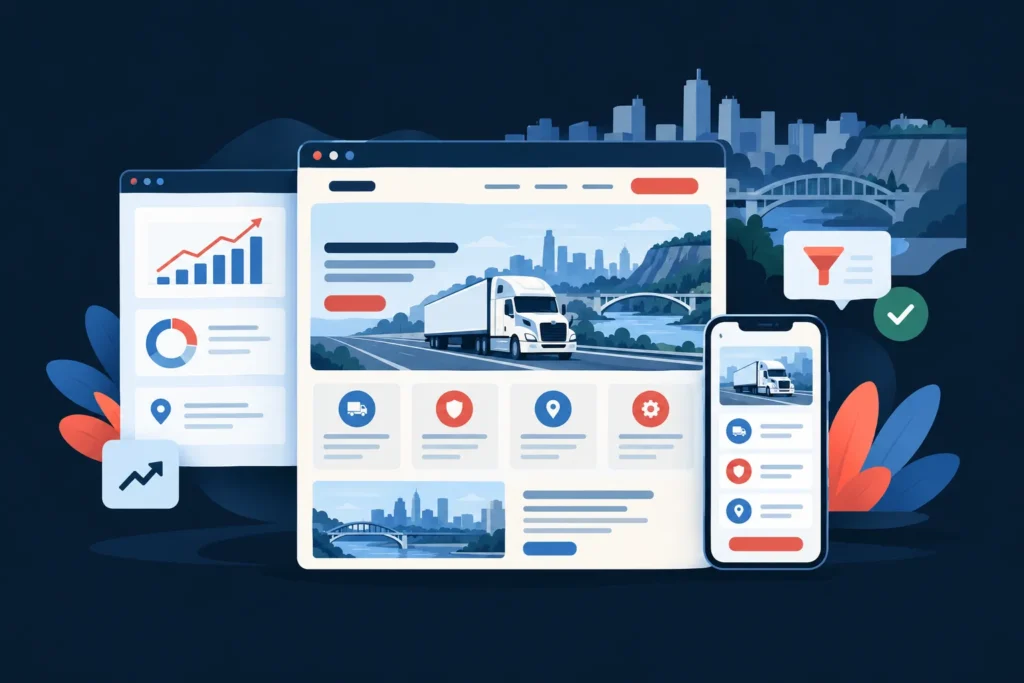
For a Hamilton trucking or logistics company, your website is more than an online brochure. It is often the first place a shipper, manufacturer, freight broker, or procurement manager checks before deciding whether to request a quote. Good Hamilton trucking web design should make your services easy to understand, your operation easy to trust, and your next step obvious.
The strongest logistics websites combine clear service information, fast mobile performance, local search visibility, and conversion paths built around real shipping enquiries. That means showing what you haul, where you operate, how customers can contact dispatch, and why your company is a dependable choice.
Contact WebDesignGTA.com for a tailored website plan for your Hamilton transportation business, or review our website portfolio to see examples of conversion-focused design work.
What a trucking company website needs to accomplish
A logistics website has a different job from a general small business website. Visitors may be trying to solve an urgent transportation problem, compare carriers for an ongoing contract, or verify whether your company can handle a particular lane, load type, or delivery schedule.
Your website should answer these questions quickly:
- What transportation and logistics services do you provide?
- Which regions, cities, terminals, and shipping lanes do you serve?
- What types of freight, equipment, or loads can you handle?
- How can a customer request a quote or speak with dispatch?
- What evidence shows that your operation is professional and reliable?
- Can a visitor contact you easily from a mobile phone?
If a potential customer cannot find those answers, they may move on to another carrier. A well-planned logistics website design turns operational information into a clear buying journey rather than making visitors search through long paragraphs or generic service pages.
Build the site around Hamilton shipping needs
Hamilton is a practical location for a transportation company because businesses in the area may be connected to manufacturing, warehousing, distribution, construction, retail, food, port activity, and regional freight movement. Your website should reflect the types of customers and shipments you actually serve instead of relying on vague claims such as “fast and reliable transportation.”
For example, a Hamilton carrier might need dedicated pages for:
- Local and regional trucking
- Less-than-truckload and full-truckload transportation
- Dedicated freight and contract carriage
- Cross-docking and warehousing coordination
- Time-sensitive deliveries
- Flatbed, dry van, reefer, or specialized equipment
- Construction, industrial, and manufacturing freight
- Ontario, GTA, Niagara, and cross-border routes
Only publish services and coverage areas that your company genuinely offers. Specificity improves both customer understanding and local SEO, while inaccurate service claims can create poor-fit enquiries and damage trust.
A practical page structure for logistics website design
Website visitors should be able to move from “Can this company help?” to “I should request a quote” with as little friction as possible. The following structure works well for many Hamilton trucking and logistics companies.
Homepage
The homepage should state your core service, operating area, and strongest commercial benefit near the top. A useful opening section might explain that your company provides dependable freight transportation for Hamilton, the GTA, and selected Ontario or cross-border routes.
Include two clear actions, such as Request a freight quote and Call dispatch. Do not make visitors choose between several equally prominent buttons. The primary action should match your most valuable enquiry.
Services pages
Give each important service enough space to explain what it includes, who it is for, what equipment is available, and how a customer can get started. A dedicated page for a real service is more useful than placing every offering in a single list.
Each page can include:
- A plain-language explanation of the service
- Typical shipment or customer use cases
- Service areas and route information
- Equipment or capacity details where appropriate
- Common questions about scheduling, pickups, and delivery
- A quote form or direct contact option
Industries served
If your company regularly serves manufacturers, distributors, contractors, retailers, or other commercial sectors, create an industry section that speaks to their operational concerns. A manufacturer may care about dependable pickup windows and production schedules. A construction company may need equipment flexibility and site coordination. A distributor may care about recurring routes and delivery consistency.
This approach makes the website more relevant than a generic “we move freight” message.
Service area page
A Hamilton logistics company can use a service area page to explain its local coverage without creating thin pages for every nearby municipality. Mention the areas you genuinely serve, such as Hamilton, Burlington, Ancaster, Stoney Creek, Grimsby, Mississauga, Brampton, and other GTA or Ontario destinations only when they reflect your actual operating model.
Explain the relationship between your Hamilton base, customer locations, terminals, and delivery routes. This creates useful context for people searching for a Hamilton logistics or trucking provider.
About and operations pages
Commercial freight buyers want to know who they are dealing with. Use your About page to show the people, experience, equipment, processes, and service standards behind the company. Photographs of your actual trucks, yard, warehouse, drivers, or dispatch operation are usually more credible than generic stock photography.
Contact and quote page
Your quote page should be simple enough to complete quickly but detailed enough to qualify the enquiry. Useful fields may include pickup location, delivery location, freight type, approximate weight or dimensions, requested dates, equipment requirements, and contact information.
Do not require every visitor to complete a long form. A phone number, email address, and concise quote form should remain visible for customers who need an immediate response.
The Freight Enquiry Pathway: an original conversion framework
A useful framework for trucking websites is the Freight Enquiry Pathway. It organizes the website around the information a shipper needs before requesting service:
- Fit: State the freight, equipment, industries, and routes you handle.
- Proof: Show real evidence such as company history, equipment photos, certifications, safety processes, customer reviews, or relevant memberships.
- Process: Explain what happens after a customer submits an enquiry, including the information you need to prepare a quote.
- Action: Make it easy to call dispatch, email your team, or complete a quote form.
Review every major page against these four stages. If the page describes a service but provides no proof or next step, it is incomplete. If it has a quote form but does not explain whether you handle the shipment, visitors may hesitate to submit it.
Trust signals that matter to freight buyers
Trust is especially important when a customer is considering a recurring transportation relationship or placing valuable freight in your care. Your website should support claims with visible, specific evidence.
- Real photographs of your trucks, equipment, facilities, and team
- Years in operation, where accurate and clearly explained
- Service capabilities and equipment specifications
- Relevant insurance, safety, compliance, or industry information
- Customer reviews or testimonials with permission
- Recognizable client or partner logos only with authorization
- Clear business contact details and a Hamilton-area location
- A professional domain email address
- Plain-language information about your quote and dispatch process
Avoid adding badges, awards, certifications, or “trusted by” statements that cannot be verified. Credibility is stronger when it is specific and honest than when the page is crowded with unsupported promises.
Mobile UX for drivers, shippers, and dispatch teams
Many visitors will reach your site from a phone while they are on a loading dock, at a job site, in a yard, or between appointments. Mobile design is therefore a business requirement, not a visual extra.
Prioritize:
- A tap-to-call phone number in the header
- A visible quote button on smaller screens
- Short forms with large, usable fields
- Readable text without excessive scrolling or pop-ups
- Compressed images that load quickly on mobile networks
- Service details that are easy to scan
- Maps and directions that do not obstruct the main contact action
Test the complete enquiry process on several phones. Check whether a visitor can find your number, submit a form, read a service page, and understand your operating area without zooming or waiting for oversized images to load.
Local SEO for a Hamilton trucking company
Local SEO Hamilton work should help search engines and potential customers understand where your company operates and what it provides. Start with consistent business information across your website and legitimate business directories. Your name, address or service-area details, phone number, and operating information should not conflict from one platform to another.
Important on-site considerations include:
- A clear Hamilton and service-area description
- Descriptive page titles and headings for real services
- Unique content for transportation services and industries served
- Accurate contact details on the website
- A properly maintained Google Business Profile, where eligible
- Useful images with descriptive file names and alternative text
- Internal links between service, industry, location, and contact pages
- Fast, secure, mobile-friendly website performance
Use phrases such as “logistics website design,” “Hamilton logistics company,” and “trucking services in Hamilton” naturally where they accurately describe the page. Do not repeat the same keyword in every heading or create location pages with nearly identical copy. Search visibility should support a useful website, not replace one.
For a broader local search strategy, see the Hamilton SEO service. A strong SEO plan can also identify the service, industry, and route questions that your prospective customers are actually asking.
Website performance and technical essentials
A professional logistics website should be secure, accessible, and easy for search engines to understand. Use HTTPS, descriptive page URLs, logical navigation, readable colour contrast, and headings that organize the content for both users and search systems.
Pay particular attention to image sizes. Truck and warehouse photography can be visually powerful, but unoptimized files can slow down the page. Use appropriately sized images, modern compression, and lazy loading where suitable. A fast website gives visitors a better experience and reduces the chance that a customer abandons a quote page.
Forms should provide a clear confirmation after submission and should route enquiries to a monitored inbox. Test notifications regularly. A beautiful website cannot generate business if quote requests disappear into an unattended mailbox.
Questions to answer before requesting a website quote
Before starting a redesign, gather the information your web designer will need:
- Which services and equipment produce the best-fit enquiries?
- Which customer industries and freight types are most important?
- Which routes and service areas do you actually cover?
- What information is required to prepare a quote?
- Who answers calls and form submissions?
- Which photographs, reviews, certifications, and documents can be used?
- What makes your operation different from competing carriers?
- Which existing pages, domains, listings, and analytics should be retained?
Preparing these details early makes the project more efficient and keeps the content grounded in your real operation.
Choosing a Hamilton logistics and trucking web designer
Look for a web designer who understands both local commercial search and the practical buying journey for transportation services. The right partner should be able to explain how the site will generate qualified enquiries, not simply how it will look.
Ask whether the project includes strategy, copy structure, mobile conversion planning, technical SEO, analytics, hosting or maintenance guidance, and post-launch improvements. Request examples of work that demonstrate clear navigation and strong calls to action rather than judging a portfolio only by visual style.
WebDesignGTA.com creates conversion-focused websites for businesses that need to be found, understood, and contacted. Our Hamilton web design service can be tailored to a trucking company, freight carrier, warehouse operator, or logistics provider with specific service-area and lead-generation goals. You can also visit the WebDesignGTA.com homepage to learn more about our approach.
Turn your website into a better source of shipping enquiries
Effective Hamilton trucking web design connects your operational strengths to the questions buyers ask before they choose a carrier. It explains your services, demonstrates reliability, supports local discovery, works on mobile devices, and gives qualified prospects a direct path to dispatch or a quote.
If your current website is difficult to update, unclear about your services, slow on mobile, or producing too few relevant enquiries, a focused redesign may be the right next step. Request a tailored website plan from WebDesignGTA.com and start with a site structure built around your freight services, Hamilton market, and sales process.