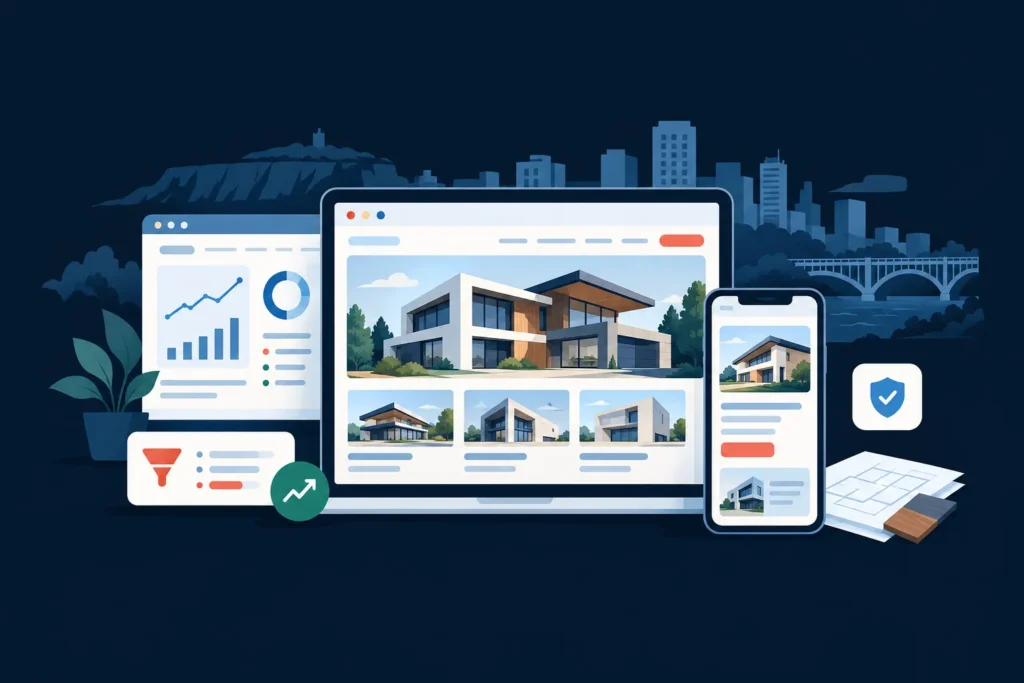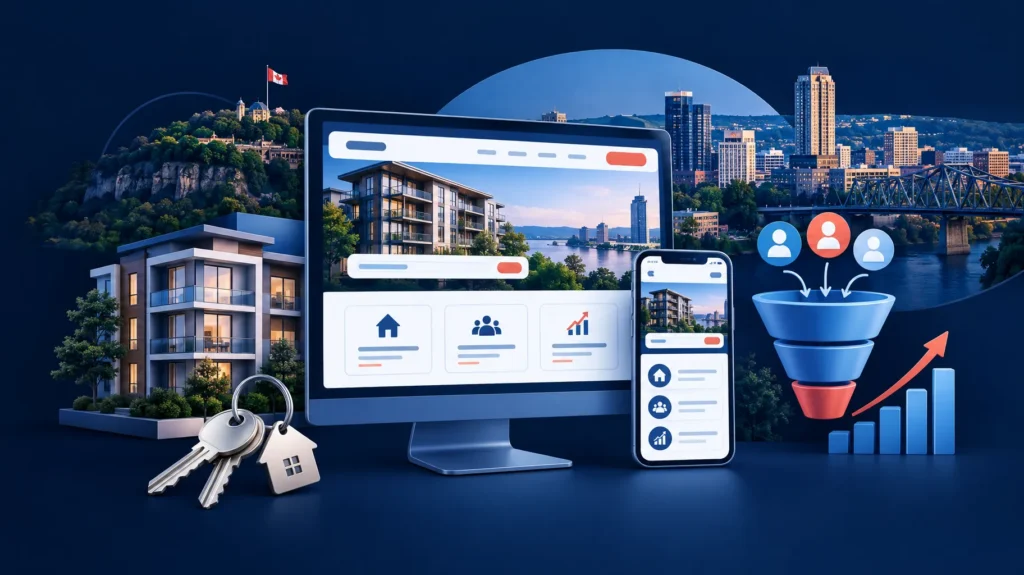
Property management web design in Hamilton should do more than present a list of rental services. It should help property owners decide whether your firm is trustworthy, help tenants find the right next step, and give qualified prospects an obvious way to call, book a consultation, or submit an enquiry.
For a Hamilton property management company, the strongest website usually combines clear service positioning, useful property information, visible proof, local search foundations, and separate conversion paths for owners and tenants. The goal is not to make every visitor follow the same journey. The goal is to help each visitor quickly understand what you manage, where you operate, and what happens next.
This guide explains how to plan a property management website design in Hamilton, including the page structure, trust signals, local SEO priorities, consultation funnel, and budget considerations.
What Hamilton prospects need before contacting a property management firm
Property owners and tenants arrive with different questions. An owner may want to know whether your company manages residential rentals, student housing, multi-unit properties, or investment properties in areas such as Ancaster, Dundas, Stoney Creek, Waterdown, or the Hamilton Mountain. A tenant may be looking for available properties, maintenance support, application instructions, or an urgent contact method.
Your website should answer the most important questions before asking someone to complete a form:
- What types of properties does the company manage?
- Which Hamilton-area communities and property types does it serve?
- What does the management service include?
- How does the company handle maintenance, communication, leasing, and inspections?
- Who will the prospect be dealing with?
- What is the next step for an owner, tenant, or applicant?
A vague statement such as “full-service property management” does not give prospects enough confidence. Explain what full service means in practical terms. For example, you might describe leasing coordination, tenant communication, rent administration, maintenance coordination, inspections, vendor management, and owner reporting, provided those services accurately reflect your business.
For broader planning principles, see this guide to small business web design in Hamilton. Property management sites need the same strong fundamentals, but they also require more carefully separated user journeys.
Positioning and trust above the fold
The first screen of a property management website should state who you help, what you manage, where you operate, and what a visitor can do next. A strong headline is specific enough to qualify visitors rather than trying to appeal to everyone.
A practical above-the-fold structure
- Headline: A clear statement about managing rental properties for Hamilton-area owners.
- Supporting copy: A concise explanation of your management approach and property types.
- Primary call to action: “Book an owner consultation” or “Request a management assessment.”
- Secondary path: “I am a tenant” or “View available properties.”
- Trust signals: Years in business, service area, professional affiliations, response expectations, or verified review information where applicable.
Do not hide the owner consultation behind a generic “Contact” button if owner acquisition is your primary commercial goal. “Contact” is familiar, but a more specific call to action tells the visitor what will happen after the click.
The design should also make urgent tenant support easy to find without allowing tenant-related content to overwhelm the owner conversion path. A visible tenant portal, maintenance request link, or tenant contact option can reduce confusion while keeping the main homepage focused.
If you are comparing providers, the Hamilton web design service from WebDesignGTA.com explains how a locally focused website project can connect design, content, mobile usability, and conversion planning.
Property management web design Hamilton: build service pages around real decisions
Service pages should help a property owner understand whether your company is the right operational fit. A single page labelled “Services” is rarely enough when different property owners have different concerns.
Recommended service and practice-area pages
- Residential property management: Explain the day-to-day responsibilities covered and the types of residential properties served.
- Leasing and tenant placement: Describe marketing, enquiry handling, showing coordination, screening processes, and lease administration accurately.
- Multi-unit or apartment management: Explain how communication, maintenance coordination, common areas, and reporting are handled.
- Investment property management: Focus on owner visibility, communication, maintenance decisions, and protecting the long-term operation of the property.
- Tenant services: Provide practical information about applications, maintenance requests, payments, and communication.
Each page should include the same basic decision-making elements:
- A clear description of the service.
- The property owner or tenant problem it addresses.
- A plain-language explanation of the process.
- What is included and what may require separate discussion.
- Relevant questions and objections.
- A specific next step.
A service page should not make promises about guaranteed occupancy, maintenance response times, or investment returns unless your business can substantiate and consistently deliver those promises. Clear boundaries are more credible than exaggerated claims.
Use bios, reviews, case studies, and proof to reduce risk
Property management is a trust-sensitive service. Owners are evaluating whether to give your company access to their property, tenants, records, and ongoing decisions. A polished visual design helps, but proof and transparency do more of the persuasion.
Trust signals worth including
- Named team members with useful biographies and professional roles.
- A clear explanation of who handles leasing, maintenance coordination, and owner communication.
- Client reviews displayed with the source and date where possible.
- Case studies describing the property challenge, approach, and scope of work without unsupported performance claims.
- Professional memberships, licences, insurance details, or certifications where relevant and current.
- Real photographs of the team, office, properties, or service process when appropriate.
- A privacy policy and clear form expectations.
Case studies do not need to reveal confidential owner information. A useful case study can describe the property type, the operational challenge, the work completed, and the resulting process improvement, provided each statement is accurate and approved for publication.
For a transferable example of how a service business can present process clarity and credibility, review the Steel City Recruitment website design project. It is not a property management example, but the principle is relevant: visitors need to understand the process, the people involved, and the next step without searching through vague marketing language.
Design separate consultation and enquiry paths
A property management website can generate more useful enquiries when it separates owners, tenants, applicants, and general questions. These visitors should not all be forced into one long form.
Owner consultation funnel
- Entry point: The visitor clicks “Book an owner consultation” from the homepage, a service page, or a local landing page.
- Qualification: The form asks for the property location, property type, approximate number of units, current management situation, and preferred contact method.
- Expectation setting: Explain what the consultation covers and how the information will be used.
- Confirmation: Show a clear confirmation message with the expected response time and any preparation instructions.
- Follow-up: Send the enquiry to the right person and track whether it was contacted.
Keep the first form focused. Asking for every possible detail can discourage a good prospect. You can gather additional information during the consultation or through a follow-up process.
Tenant and applicant paths
Tenant visitors may need a property search, application information, maintenance instructions, or a general contact route. Those actions should be available from the main navigation and mobile menu. If the business uses a separate property listing or tenant portal, link to it clearly and explain what the visitor will find there.
Every form should work well on a phone, identify required fields, provide useful error messages, and make privacy expectations clear. Forms that technically submit but do not confirm the next step create unnecessary uncertainty for both the visitor and the business.
Hamilton local SEO for property management companies
Local SEO helps a property management company become easier to understand and discover when people search for services in Hamilton, Ontario. It does not replace a useful website. Search visibility is more valuable when the landing page answers the visitor’s actual questions and provides a credible next step.
Start with a well-organized website that clearly identifies the business, service category, service area, contact details, and relevant property management services. Use the business name, address, phone number, and operating information consistently across the website and eligible business listings.
Local search priorities
- Create a dedicated Hamilton property management service page rather than relying only on the homepage.
- Describe the communities you genuinely serve, including nearby areas only where they are operationally relevant.
- Publish useful answers to owner questions about management processes, maintenance coordination, leasing, and communication.
- Use descriptive page titles, headings, URLs, image alternative text, and internal links.
- Keep your Google Business Profile information accurate and aligned with the website.
- Ask for genuine reviews through an appropriate business process and never manufacture testimonials.
- Make the website fast, accessible, secure, and easy to use on mobile devices.
Google’s documentation recommends creating helpful, reliable, people-first content and using structured data accurately when it applies. Its guidance on SEO fundamentals and structured data can help your developer or SEO provider make informed technical decisions. Structured data can help search engines interpret a page, but it does not guarantee enhanced results or rankings.
For a broader local strategy, read about web design and SEO in Hamilton. Property management companies should connect that foundation to owner-focused service pages rather than publishing generic city content.
Common property management website mistakes
1. Speaking only to tenants
Tenant resources are important, but owners are often the primary commercial audience. Make owner services visible from the homepage and navigation.
2. Using one generic service paragraph
Visitors need to understand what you actually manage. Separate services and property types make the business easier to evaluate.
3. Hiding the team
Anonymous websites can feel risky for a relationship-based service. Add real names, roles, and useful background information.
4. Relying on stock images alone
Professional photography is not mandatory, but a website made entirely from generic apartment images may not communicate local credibility. Use authentic images where they strengthen trust.
5. Making the form too long
Collect enough information to qualify the enquiry, but avoid turning the first conversation into an administration task.
6. Treating mobile design as an afterthought
Owners, tenants, and applicants may contact a company from a phone. Buttons, menus, forms, phone numbers, and property information must remain easy to use on smaller screens.
7. Making unsupported promises
Avoid guaranteed rankings, guaranteed occupancy, guaranteed returns, or vague claims about results. Accurate service descriptions build stronger long-term trust.
Original homepage wireframe for a Hamilton property management website
A practical homepage structure for a Hamilton property management company could look like this:
- Header: Logo, owner consultation button, tenant resources link, and phone number.
- Hero section: Specific Hamilton-area positioning, short supporting copy, owner consultation CTA, and tenant pathway.
- Service overview: Residential management, leasing, multi-unit management, and tenant support cards.
- Why owners choose the company: A short explanation of communication, maintenance coordination, reporting, and local service knowledge.
- Process section: Assessment, transition planning, ongoing management, and reporting.
- Proof section: Reviews, team credentials, case studies, and relevant affiliations.
- Service area section: Hamilton and the specific nearby communities genuinely served.
- Frequently asked questions: Clear answers about services, fees, onboarding, maintenance, and owner communication.
- Final CTA: A concise consultation invitation with a short form or booking option.
Trust-signal checklist
- Is the legal or operating business name clear?
- Can a visitor find a phone number quickly?
- Are owner and tenant actions separated?
- Does the website explain the management process?
- Are team members identified?
- Are reviews and case studies authentic and attributable?
- Are service areas accurate?
- Does the consultation form explain what happens next?
- Does every key page work properly on mobile?
Suggested sitemap for a Hamilton property management company
- Home
- About the company
- Property management services
- Residential property management
- Leasing and tenant placement
- Multi-unit property management
- For property owners
- For tenants
- Available properties
- Resources or frequently asked questions
- Service areas
- Contact and owner consultation
The final sitemap should reflect the company’s actual services and operational capacity. A smaller firm may need fewer pages with stronger content rather than a large website filled with thin location pages.
Frequently asked questions
How much does property management web design cost in Hamilton?
The cost depends on the number of pages, custom design requirements, content preparation, integrations, booking or portal connections, photography, accessibility work, and ongoing SEO. A small brochure-style site may require a lower investment, while a custom property management website with owner and tenant workflows requires more planning and development. The most useful way to compare proposals is to evaluate the included strategy, content, functionality, support, and ownership terms, not just the starting price. For context, review this Hamilton web design cost guide.
What pages should a property management website have?
Most property management websites need a homepage, company or team page, service pages, owner information, tenant resources, available properties if applicable, frequently asked questions, service areas, and a contact or consultation page. The exact structure should reflect the firm’s property types, target clients, and operational process.
How can a Hamilton property management website generate more leads?
It can generate better leads by making owner services prominent, explaining the management process, showing credible proof, targeting relevant Hamilton searches, separating owner and tenant pathways, and offering a specific consultation CTA. The website should also make it easy to call from a mobile device and should send form submissions to a reliable follow-up process.
Does a property management business in Hamilton need local SEO?
Local SEO is valuable when the company wants to be found by property owners searching for management services in Hamilton and nearby communities. It helps search engines and potential clients understand the company’s location, services, and service area. Local SEO works best when it supports accurate business information, useful service pages, strong technical foundations, and genuine customer feedback.
Plan a website that supports the whole property management business
A successful property management website should support more than marketing. It should reduce confusion for tenants, qualify owner enquiries, explain the company’s process, and give staff a practical place to direct prospects. That requires decisions about content, page hierarchy, forms, local search, mobile usability, and follow-up before visual design begins.
Own a property management business in Hamilton? Get a tailored website and local SEO plan from WebDesignGTA.com.
Recommended implementation includes an Article and BreadcrumbList schema. FAQ markup may be appropriate only when the visible questions and answers on the published page meet current search-engine eligibility requirements. Use accurate business and service information, and validate any structured data before publishing.
Suggested featured image filename: property-management-web-design-hamilton.jpg
Suggested image alt text: Responsive property management website design shown on desktop and mobile screens with Hamilton-inspired city details
Fact-check and source list: Google Search Central, SEO Starter Guide; Google Search Central, Introduction to structured data markup; Government of Canada, privacy and consumer information resources; WebDesignGTA.com, official website and linked service and portfolio pages.