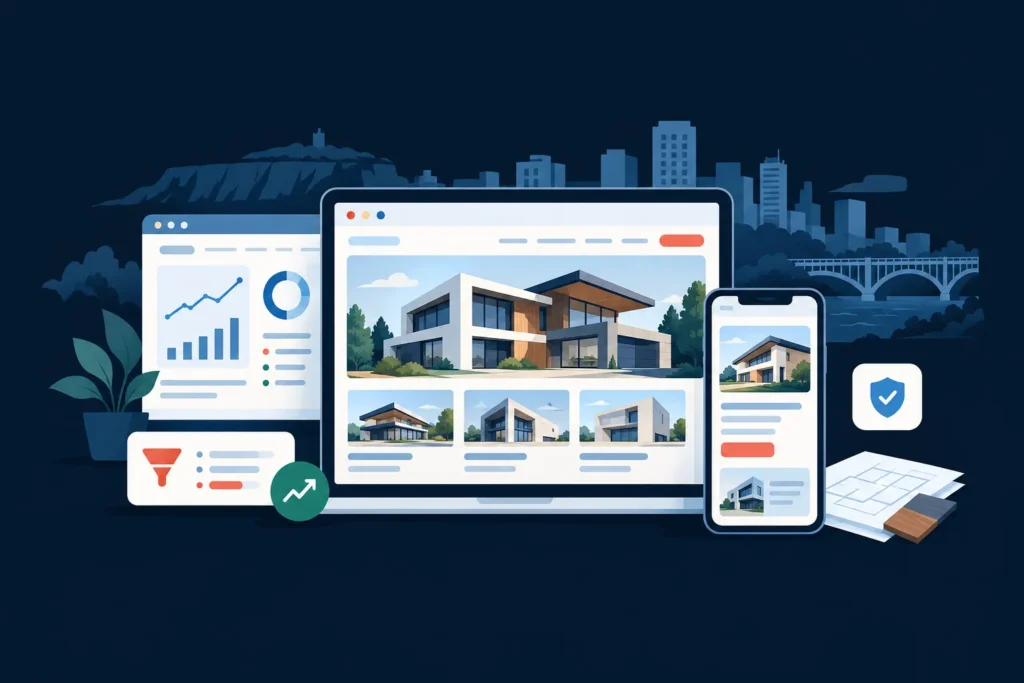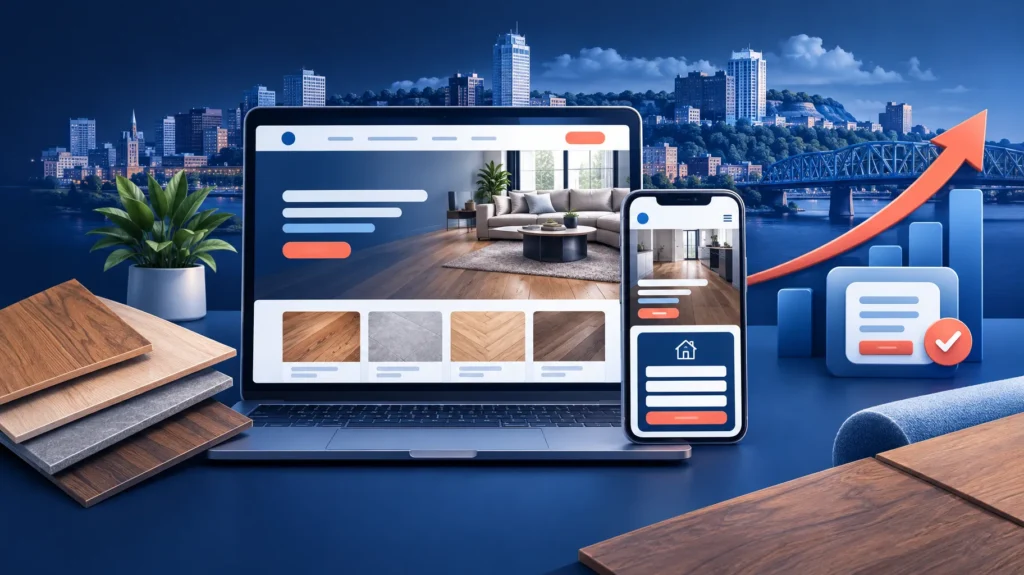
For a flooring company in Hamilton, a website should do more than display beautiful floors. It should help a homeowner decide what to do next: call, request an estimate, book a consultation, or send project details from a phone. Effective flooring web design in Hamilton combines project photography, clear service information, local search visibility, and conversion-focused calls to action.
The strongest flooring websites are organised around the questions customers ask before contacting a contractor: What types of flooring do you install? Do you serve my area? Can you help me choose the right material? How much information should I provide for an estimate? Are your installers experienced and dependable?
This guide explains how to structure a flooring website for Hamilton customers, including a practical homepage wireframe, service-area sitemap, local SEO plan, and call-versus-quote conversion flow.
How Hamilton customers search for flooring services
Flooring customers often begin with a specific need rather than a company name. Their searches may relate to the material, the room, the project type, or the location. Examples include “engineered hardwood installation Hamilton,” “vinyl plank flooring near me,” “basement flooring contractor,” and “flooring company in Ancaster.”
That search behaviour creates several opportunities for a flooring business. A website can attract customers who are still researching materials, customers comparing local contractors, and customers ready to request an estimate. These visitors should not all be sent to the same generic contact page.
A useful flooring website matches the page to the search intent:
- Material searches: Create pages for hardwood, laminate, luxury vinyl plank, carpet, tile, or other services the company genuinely provides.
- Project searches: Explain flooring for kitchens, basements, stairs, condos, rental properties, and commercial spaces where relevant.
- Local searches: Make it clear that the company serves Hamilton and appropriate nearby communities.
- Decision-stage searches: Provide an estimate request form, phone number, project photos, reviews, and an explanation of the next steps.
This is where professional website design for Hamilton businesses can support both visibility and enquiries. The goal is not to add every possible keyword. The goal is to make the business, its services, and its service area easy for customers and search engines to understand.
What should appear above the fold?
The first screen of a flooring website should immediately communicate three things: what the company does, where it works, and how the visitor can get started. A strong headline might say, “Flooring Installation in Hamilton for Homes, Condos, and Commercial Spaces.” The supporting text can explain the main materials or project types served.
The header should include a visible phone number and a primary estimate button. On mobile, the phone number should be easy to tap without requiring the visitor to open a menu. A secondary action such as “View Flooring Services” can help visitors who need more information before making contact.
Recommended above-the-fold structure
- Headline: State the service and Hamilton location clearly.
- Supporting paragraph: Briefly explain the company’s installation, replacement, or consultation services.
- Primary CTA: “Request a Flooring Estimate.”
- Secondary CTA: “Call for a Consultation.”
- Trust cues: Years in business, material expertise, warranty information, review rating where accurately displayed, or a statement about serving residential and commercial customers.
- Hero image: Use a real completed project whenever possible, rather than a generic stock image.
The two calls to action should lead to different low-friction paths. A visitor who has questions may prefer a phone call. Someone comparing options after hours may prefer a form. Both paths should remain available throughout the site.
Original flooring homepage wireframe
A flooring homepage should guide visitors from recognition to confidence and then to contact. The following structure is a practical starting point for a Hamilton flooring company.
- Hero section: Flooring service, Hamilton location, project image, phone button, and estimate button.
- Quick service overview: A concise introduction to the main flooring materials and installation services.
- Why customers choose the company: Explain the consultation process, workmanship, product knowledge, scheduling, and cleanup without making claims that cannot be verified.
- Featured project gallery: Show close-up details and completed rooms with useful descriptions.
- How the estimate process works: Consultation, product selection, measurements, written estimate, scheduling, and installation.
- Reviews and trust section: Display genuine review content and link to the relevant source when appropriate.
- Service-area section: Mention Hamilton and the nearby communities actually served.
- Frequently asked questions: Address preparation, timelines, flooring options, estimates, and maintenance.
- Final CTA: Repeat the phone number and estimate form with a clear next step.
This layout is more useful than placing every service in a long list. Each section answers a question that affects the visitor’s decision and moves the visitor closer to a call or estimate request.
Essential pages for a flooring website
A flooring website should have enough depth to explain the business properly, but it should not force customers to navigate through unnecessary pages. The right page set depends on the company’s actual materials, installation process, and target customers.
Core pages
- Home: A clear overview of flooring services, location, proof, and next steps.
- About: The company’s experience, approach, team, and standards.
- Flooring services: A central page that introduces the complete service range.
- Individual material pages: Hardwood, engineered hardwood, laminate, vinyl plank, carpet, tile, or other genuine specialities.
- Projects or gallery: Organised photos with descriptions of the material, room, and installation challenge.
- Estimate page: A focused form with clear expectations about what happens after submission.
- Contact: Phone, email, service area, hours, and an alternative contact method.
- FAQ: Answers to practical questions that may otherwise delay a decision.
Material pages should help customers make informed choices. For example, a luxury vinyl plank page could discuss appearance, moisture considerations, installation areas, subfloor preparation, and maintenance. It should not present one material as suitable for every room or household.
For more guidance on planning the pages of a local service website, see this resource on small business web design in Hamilton. Flooring companies can apply the same fundamentals while adding material-specific content and project proof.
Hamilton service-area and neighbourhood strategy
A flooring company serving Hamilton should create a clear service-area structure rather than repeating a list of neighbourhoods on every page. The website should first establish Hamilton as the primary market, then identify nearby areas that the business genuinely serves.
A useful service-area sitemap might look like this:
- Service Areas
- Hamilton flooring installation
- Flooring in Ancaster
- Flooring in Dundas
- Flooring in Stoney Creek
- Flooring on Hamilton Mountain
- Flooring in Waterdown
- Flooring in Binbrook
Only create a separate page when the company can provide genuinely useful information for that area. A thin page that simply replaces “Hamilton” with “Ancaster” is unlikely to help customers. A stronger local page can discuss the types of homes or projects commonly served, access and preparation considerations, relevant completed work, and the estimate process.
Location pages should also include a service-area call to action. A homeowner in Waterdown should not have to wonder whether the company travels there or whether an estimate is available.
Project photos, reviews, licences, and trust signals
Flooring is a visual purchase, but photographs alone are not enough. Customers also need reassurance that the company is organised, experienced, and suitable for their project.
Use project photos that show more than a wide room shot. Include transitions, stair details, trim, edges, patterns, installation around cabinets, and finished spaces. Captions can identify the material and project type without revealing private customer information.
Trust content may include:
- Genuine customer reviews presented accurately.
- Relevant licences, insurance, memberships, or certifications where applicable.
- Warranty and workmanship information written in plain language.
- Real team or installer photographs.
- Clear information about measurements, product selection, preparation, and cleanup.
- Before-and-after photos where permission has been obtained.
- A written explanation of what an estimate includes.
Do not display awards, certifications, review counts, or guarantees unless the business can substantiate them. Trust is weakened when a website uses vague claims that cannot be confirmed.
A related local service-business website example is Hamilton Comfort Heating & Air. Although it is not a flooring company, the transferable principle is important: a home-service website should make the service, local context, and next action understandable before the visitor has to search for them.
Google Business Profile and local SEO integration
A flooring website and Google Business Profile should support the same business information. The business name, phone number, website, service area, business category, hours, photos, and service descriptions should be kept accurate and consistent.
Google’s official guidance explains that businesses should manage their Business Profile to control how information appears on Google Search and Maps. The website should reinforce that information with useful service pages, clear contact details, and location-specific content.
Local SEO for a Hamilton flooring company can include:
- Claiming and maintaining an accurate Google Business Profile.
- Using a consistent business name, address or service-area information, and phone number.
- Publishing detailed pages for genuine flooring services.
- Adding descriptive project images and accurate image text.
- Requesting honest reviews from real customers without offering incentives that violate platform policies.
- Building relationships with relevant local suppliers, designers, contractors, or community organisations where appropriate.
- Adding appropriate LocalBusiness or service structured data with accurate information.
Local SEO cannot replace a confusing website. If a visitor arrives from Google and cannot find the phone number, services, service area, or estimate process, visibility will not translate efficiently into enquiries. The relationship between web design and SEO in Hamilton should therefore be planned from the beginning.
Mobile speed and conversion essentials
Many flooring customers will first view a website on a mobile device while travelling, comparing contractors, or discussing a renovation at home. A mobile website needs to load efficiently, remain easy to read, and make contact simple.
Important conversion essentials include:
- A tap-to-call phone number in the header or sticky mobile navigation.
- Large buttons with specific labels such as “Request an Estimate.”
- Short forms that ask only for information needed to begin the conversation.
- Compressed project images that retain quality without unnecessarily slowing the page.
- Readable text, strong colour contrast, and sufficient spacing between buttons.
- No intrusive pop-ups that cover the estimate form or phone number.
- A confirmation message explaining what happens after a form is submitted.
- Fast access to service pages without excessive animation or complicated menus.
Google’s PageSpeed Insights documentation provides tools for evaluating loading performance and user experience. Performance should be checked on real pages, especially the homepage, service pages, and estimate form. A visually impressive website that is slow or difficult to use on a phone can create unnecessary friction.
Call versus quote: a practical lead-generation flow
Flooring customers have different levels of urgency and different amounts of information available. The website should support both immediate calls and considered estimate requests.
Call flow
- The visitor sees the phone number in the header and hero section.
- The visitor taps to call from a mobile device.
- The page explains what information to have ready, such as room type, approximate size, flooring preference, and project timing.
- The visitor receives a clear next step, such as a consultation or measurement appointment.
Quote flow
- The visitor selects “Request an Estimate.”
- The form asks for name, contact details, project location, room or project type, preferred material, approximate timing, and an optional photo upload.
- The confirmation page explains when the company will respond and what happens next.
- The business follows up with a useful conversation rather than treating the form as a complete sales process.
Do not ask for a long project brief before a customer has developed trust. A short first-step form usually creates less friction than an extensive questionnaire. Additional details can be collected during the call or consultation.
How much does flooring web design cost in Hamilton?
The cost depends on the number of pages, the quality of the photography and content, custom design requirements, estimate-form functionality, local SEO work, and whether ongoing updates are included. A small brochure-style site generally requires less work than a custom website with material pages, project galleries, service-area content, integrations, and ongoing optimisation.
For a more detailed discussion of the factors that affect pricing, review this Hamilton web design cost guide. The best comparison is not the lowest initial price. It is whether the website gives customers enough information to choose the company and provides a reliable path to an enquiry.
How can a Hamilton flooring website generate more leads?
A flooring website can generate more qualified enquiries by presenting a clear service offer, strong project evidence, accurate local information, mobile-friendly contact options, and a simple estimate process. Each important service should have a dedicated page, and each page should guide the visitor to either call or request an estimate.
Track practical actions such as phone clicks, form submissions, estimate requests, and consultation bookings. These actions are more useful than judging the site only by visitor numbers. Avoid guaranteeing a particular number of leads or rankings, because results depend on competition, reviews, service quality, market demand, and follow-up.
Does a flooring business in Hamilton need local SEO?
Local SEO is valuable when a flooring company wants to be found by customers searching for nearby installation or flooring services. It helps connect the company’s website and Business Profile with the services and areas it actually serves. Local SEO is not a substitute for a good website, accurate business information, or strong customer service. It works best when all three support the same customer journey.
For a company that wants a broader local search strategy, Hamilton SEO services can be planned alongside the website rather than added as an afterthought.
Plan a flooring website around the estimate request
The most effective flooring website is not simply a digital brochure. It is a structured sales tool for Hamilton homeowners, landlords, designers, renovators, and commercial customers. It answers material questions, demonstrates workmanship, explains the service area, builds trust, and makes the next step obvious.
If you are comparing flooring website design options, prioritise a provider that can connect content, local search, mobile usability, project proof, and conversion paths. A site built around those decisions will be more useful than one built around visual effects alone.
Own a flooring business in Hamilton? Get a tailored website and local SEO plan from WebDesignGTA.com.
Sources and fact-check references
- Google Business Profile Help, for managing business information on Google Search and Maps.
- Google Search Central Local Business structured data guidance.
- Google PageSpeed Insights documentation, for evaluating page performance and user experience.
- Google guidance for improving local ranking.