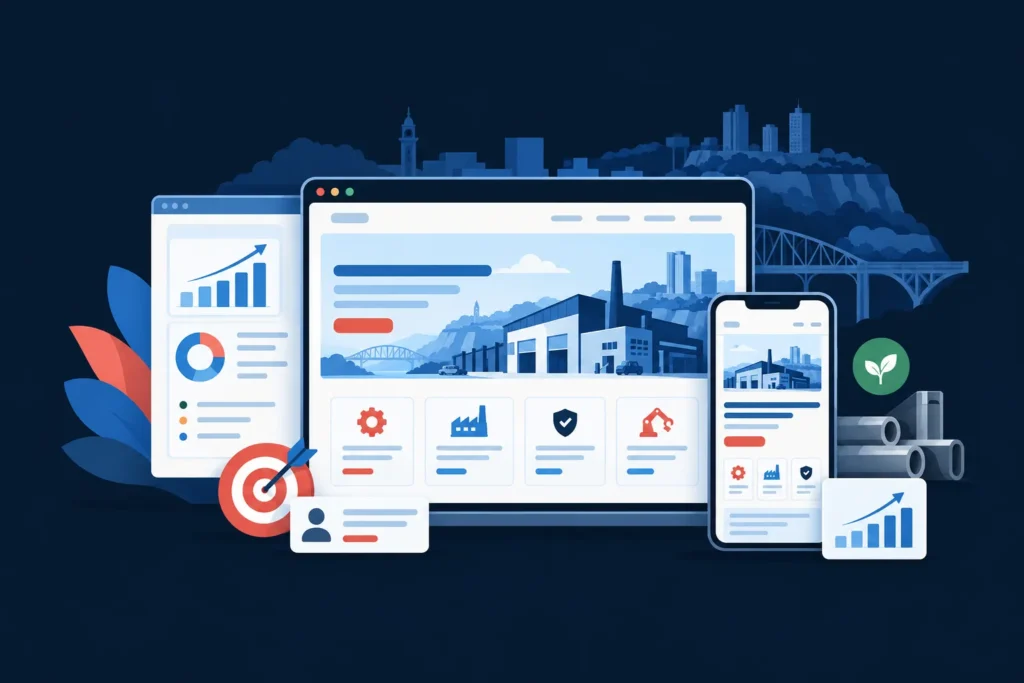
For a Hamilton retailer, effective ecommerce web design in Hamilton should do more than display products. It should help local customers discover your business, understand what you sell, trust your store, complete a purchase, and contact you when they need advice. A strong website combines clear product information, simple mobile shopping, local SEO, secure checkout, and conversion-focused calls to action.
This guide explains how to plan a retail or ecommerce website for customers in Hamilton, Ancaster, Dundas, Stoney Creek, Hamilton Mountain, Waterdown, and nearby communities. It also includes a practical homepage wireframe, a local ecommerce sitemap, an enquiry flow, and the key measurements to review after launch.
How Hamilton customers discover local retailers online
Hamilton shoppers may find a retailer through Google Search, Google Maps, social media, a product recommendation, a local event, or a direct search for a known business. Each discovery path creates a slightly different expectation.
- A customer searching for a product wants to see availability, pricing, product details, delivery options, and a straightforward way to buy.
- A customer searching for a local store wants the address, hours, service area, parking or pickup information, and directions.
- A customer arriving from Instagram or Facebook often needs more visual proof, product context, and reassurance before purchasing.
- A customer searching for a specialist retailer may need advice, sizing help, consultation, custom ordering, or an enquiry form before making a decision.
Your website should support all of these journeys. A Hamilton store that sells home goods, apparel, gifts, specialty food, furniture, beauty products, or other retail products may need both ecommerce functionality and local service information. The correct structure depends on how customers buy from the business.
For a broader planning framework, review this guide to web design and SEO in Hamilton. It explains how website structure and search visibility work together to generate local enquiries.
What makes ecommerce web design in Hamilton effective?
Effective retail ecommerce website design in Hamilton connects four elements: discoverability, usability, trust, and action. If a website ranks but is difficult to use, visitors leave. If it looks polished but does not explain delivery, returns, or product details, customers hesitate. If checkout is simple but the store cannot be found locally, sales opportunities are missed.
1. Discoverability
Important product categories and local services should be represented by indexable pages with clear names. A retailer might need pages for online shopping, in-store pickup, custom orders, gift cards, delivery areas, and product categories rather than placing everything inside one gallery.
2. Usability
Visitors should be able to find a product, compare options, add an item to their cart, and complete checkout without unnecessary steps. Navigation should reflect how customers think about the products, not how the internal inventory system is organized.
3. Trust
Visible contact information, accurate store hours, product photography, reviews, policies, payment details, and clear delivery information reduce uncertainty. Trust is especially important when a customer has not visited the store before.
4. Action
Every important page should provide an appropriate next step. That might be Shop now, Check availability, Book a consultation, Request a custom order, or Call the store. The call to action should match the customer’s buying stage.
WebDesignGTA.com provides Hamilton web design services for businesses that need a locally focused website strategy rather than a generic template with a city name added to it.
A homepage structure that helps local shoppers take action
A strong ecommerce homepage should quickly answer three questions: what do you sell, where do you serve customers, and what should the visitor do next?
Recommended retail and ecommerce homepage wireframe
- Header: Place the logo, primary navigation, search, cart, phone number where appropriate, and a clear mobile menu at the top.
- Local value proposition: Explain what the store sells and why Hamilton customers should choose it. Include a primary button such as Shop online or Browse collections.
- Featured categories: Show the main product groups with useful photography and descriptive links.
- Current offer or seasonal collection: Promote a real collection, event, gift guide, or seasonal product group. Avoid making the entire homepage depend on a temporary promotion.
- Local buying options: Explain delivery, local pickup, in-store shopping, appointment options, or service areas in plain language.
- Best sellers or selected products: Use product cards with pricing, key options, availability where possible, and direct links.
- Why shop with us: Summarize expertise, sourcing, product quality, customer service, customization, or local ownership without making unsupported claims.
- Reviews and proof: Add genuine customer reviews, media mentions, user-generated content, or links to active social profiles.
- Store information: Include the Hamilton location, hours, contact details, map link, and an appropriate local call to action.
- Footer: Link to shipping, returns, privacy, terms, contact, FAQs, social channels, and important product categories.
Do not make the homepage carry every detail. Its job is to orient visitors and send them to the right next page. Product and service pages should answer the more specific questions that affect a purchase.
Essential pages for a Hamilton retail ecommerce website
The right sitemap depends on your catalogue and fulfilment model, but most local retailers benefit from the following structure.
- Home: A concise overview of the store, products, location, and main buying paths.
- Shop: A searchable product catalogue with categories, filters, sorting, and useful product information.
- Category pages: Dedicated pages for important product groups, collections, or customer needs.
- Product pages: Clear photography, pricing, variants, dimensions or sizing, materials, availability, delivery details, and returns information.
- About: The business story, expertise, approach, and connection to Hamilton.
- Visit the store: Address, hours, parking or access information, map, and directions.
- Delivery and pickup: Service areas, costs, estimated timing, pickup instructions, and order notifications.
- Shipping and returns: Policies written in plain language and easy to find before checkout.
- Custom orders or consultations: A form or booking path for products that require advice, measurements, personalization, or a quote.
- Contact: Phone, email, form, hours, and expected response information.
- FAQ: Answers to common questions about products, checkout, pickup, delivery, payment, and returns.
Retailers with a smaller product range may not need a large catalogue. A focused website with strong product pages and a well-designed enquiry flow can be more effective than a complex store that is difficult to maintain.
If you are comparing project scope and investment, this Hamilton web design cost guide provides useful context for the factors that affect a small-business website budget.
Booking and enquiry flow for products that need assistance
Not every retail purchase should be forced through an online cart. Furniture, custom gifts, specialty apparel, high-value products, and made-to-order items often need a conversation first.
A practical local enquiry flow
- The visitor lands on a product or service page and sees a clear option to request help.
- The form asks only for useful information, such as name, contact details, product of interest, preferred date, measurements, budget range, and message.
- The confirmation page explains what happens next and provides an alternative phone number for urgent questions.
- The business receives the enquiry with enough detail to respond efficiently.
- The staff member follows up with product recommendations, availability, a consultation time, or a quote.
For consultations, use a booking tool that shows real availability and sends confirmation details. For custom orders, a structured form is often better than a generic “send us a message” box. The goal is to reduce back-and-forth while keeping the experience personal.
Photos, reviews, and social proof that support ecommerce sales
Retail websites are visual, but attractive photography alone does not establish enough confidence. Customers need to understand scale, materials, colour, fit, packaging, use, and the experience of buying from the store.
- Show products from multiple useful angles.
- Include close-up images where texture or construction matters.
- Use consistent image sizes so category pages are easy to scan.
- Show products in context when scale or styling affects the decision.
- Use descriptive image alternative text for accessibility and clarity.
- Display genuine reviews near the relevant product or service.
- Explain how reviews are collected when that context is useful.
- Link to active social profiles rather than embedding a slow, distracting feed everywhere.
A related local retail project, Rolly & Bubbly Icecream, demonstrates a transferable principle for consumer-facing websites: strong visual presentation should be paired with clear information and an obvious next step. The project is not an ecommerce example for every retail category, but the approach to presenting a local consumer brand can inform product, location, and conversion design.
Google Business Profile and local SEO for retailers
Local SEO helps a Hamilton retailer appear when nearby customers search for relevant products or store visits. It does not replace a useful website or guarantee rankings. It makes the business information easier for search engines and customers to understand.
Start with a verified and accurate Google Business Profile. Keep the business name, address, phone number, hours, website, category, services, products, and photos current. Update holiday hours and temporary changes promptly.
Local ecommerce SEO checklist
- Use one clear, descriptive page title for each important page.
- Write useful product and category descriptions instead of relying only on manufacturer copy.
- Include Hamilton context where it helps customers understand delivery, pickup, or store access.
- Keep address and contact details consistent across the website and business listings.
- Add a clear contact or location page with directions and hours.
- Connect the website to the Google Business Profile.
- Use descriptive internal links between categories, products, delivery information, and contact pages.
- Make sure important pages can be reached through normal navigation and are not hidden behind scripts alone.
- Use structured product information where supported by the ecommerce platform and search guidelines.
- Ask satisfied customers for honest reviews without offering incentives that violate platform policies.
Google’s SEO Starter Guide and local business guidance are useful primary references. For more local lead-generation context, see small business web design in Hamilton and the related page planning recommendations.
Mobile UX and page speed matter at the point of purchase
Many retail visitors browse on a phone while commuting, comparing products in a store, or deciding whether to visit a location. Mobile design should therefore be treated as the primary shopping experience, not a smaller desktop version.
- Keep navigation and search easy to access with one hand.
- Use large tap targets for filters, product options, and checkout controls.
- Keep product images sharp but compressed appropriately.
- Limit distracting popups, especially before a visitor can see the product.
- Make forms short and use appropriate mobile keyboards.
- Show delivery, pickup, and returns information before checkout.
- Test checkout on current phones and common browsers.
Google’s PageSpeed Insights documentation and Core Web Vitals guidance provide current technical references. Page speed is only one part of the experience, so improvements should be balanced against product photography, accessibility, functionality, and clarity.
What to track after launching the website
Tracking should show whether the website is helping the business, not simply how many people visited. Configure analytics and ecommerce or form tracking before launch where possible.
- Product views and category-page engagement.
- Search usage and searches that return no results.
- Add-to-cart activity and checkout completion.
- Purchases by device type and traffic source.
- Online pickup or delivery selections.
- Calls, contact form submissions, consultation bookings, and custom-order enquiries.
- Clicks for directions, store hours, email, and phone numbers.
- Landing pages that attract local organic traffic.
- Abandoned checkout steps and common customer questions.
Review this information monthly during the first few months. If visitors view products but rarely add them to a cart, improve product information, photography, pricing visibility, or delivery explanations. If visitors reach checkout but do not complete it, test the form, payment options, account requirements, shipping costs, and mobile usability.
Example sitemap for a Hamilton retailer
- Home
- Shop
- Shop by category
- Featured collection
- Product detail pages
- Gift cards
- Custom orders or consultations
- Delivery and local pickup
- Shipping and returns
- About the business
- Visit our Hamilton store
- FAQs
- Contact
This structure can be adapted for a business serving Hamilton Mountain, Waterdown, Binbrook, Ancaster, Dundas, Stoney Creek, or customers across Ontario. The important principle is to separate shopping, visiting, service, and support information so each visitor can find the right path quickly.
Frequently asked questions
How much does retail or ecommerce web design cost in Hamilton?
There is no single price because the cost depends on the number of products, catalogue management, payment and shipping integrations, content, photography, booking requirements, custom functionality, and ongoing support. A small product catalogue with a simple checkout generally requires less work than a large store with inventory synchronization and complex fulfilment. A practical estimate should be based on your sitemap, ecommerce requirements, content needs, and business goals. Request a tailored scope rather than choosing a package based only on page count.
What pages should a retail or ecommerce website have?
Most retailers need a homepage, shop or catalogue, category pages, product pages, about page, contact page, location information, delivery or pickup details, shipping and returns policies, and FAQs. Businesses selling custom or high-consideration products may also need consultation, booking, or custom-order pages.
How can a Hamilton retail or ecommerce website generate more leads?
Make the value proposition clear, show products accurately, provide local pickup or delivery information, add strong calls to action, simplify enquiry forms, display genuine proof, and make phone and contact details easy to find. Track calls, forms, bookings, directions, and purchases so you can improve the pages that influence customer decisions.
Does a retail or ecommerce business in Hamilton need local SEO?
Local SEO is valuable when customers visit a store, search for nearby products, use local pickup, or want a business they can contact in Hamilton. Ecommerce retailers serving customers across Ontario also need broader product SEO, while local pages and Google Business Profile information support nearby discovery and in-person sales.
Build a retail website around how customers actually buy
The best Hamilton retail and ecommerce website is not necessarily the one with the most features. It is the one that makes the next step clear for each type of customer, from a local shopper looking for store hours to a returning customer completing checkout on a phone.
WebDesignGTA.com can help you plan the sitemap, ecommerce experience, local SEO foundation, content, and conversion paths around your actual retail operation. Own a retail or ecommerce business in Hamilton? Get a tailored website and local SEO plan from WebDesignGTA.com.