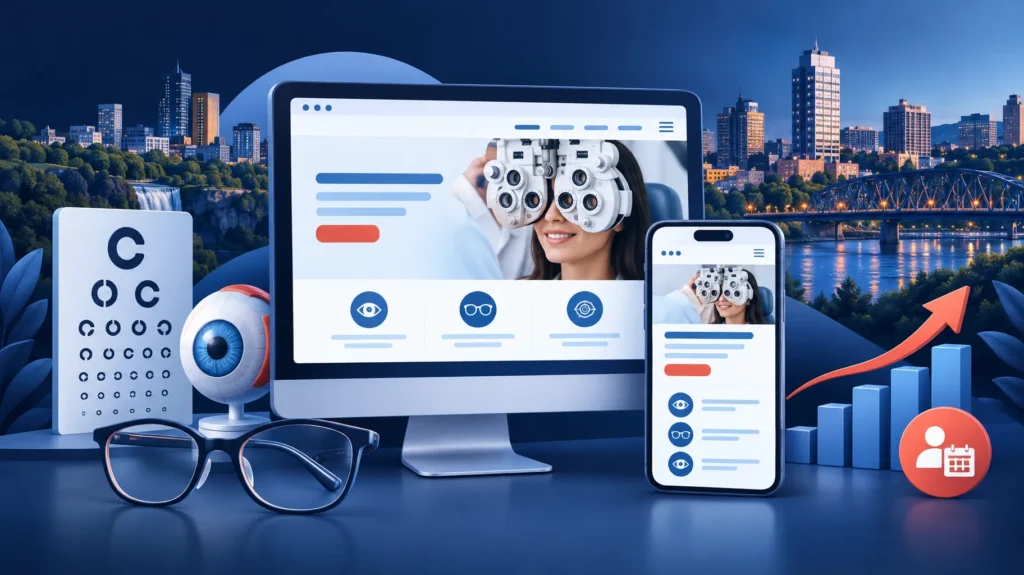
For an optometry clinic in Hamilton, a website should do more than display a phone number and list eye-care services. Effective optometry web design in Hamilton helps prospective patients understand what the clinic offers, decide whether they can trust the team, and book an appointment from any device.
The strongest optometry websites combine clear service pages, practitioner credibility, accessible content, fast mobile performance, local search visibility and a simple booking path. For a clinic serving Hamilton, Ancaster, Dundas, Stoney Creek, Hamilton Mountain, Waterdown or Binbrook, the website should make the next step obvious: book an eye exam, call the clinic or request an appointment online.
This guide explains the structure an eye clinic website needs to generate more qualified enquiries without relying on exaggerated claims or complicated user journeys. For broader planning, see this practical guide to small business web design in Hamilton.
How Hamilton patients choose an optometry clinic online
Patients commonly compare several clinics before contacting one. They want to know whether the location is convenient, whether the clinic provides the service they need, whether the team appears experienced and whether booking will be easy.
That means an optometry website must answer important questions quickly:
- What type of eye care does the clinic provide?
- Where is the clinic located, and is parking or transit access clear?
- Does the clinic offer routine eye exams, children’s eye care, contact lenses, eyewear or urgent assessments?
- Who will provide care, and what can patients expect during a visit?
- Can a patient book online or speak with the clinic without searching through several pages?
- What insurance, payment or appointment information should a new patient know?
A polished visual design helps create a professional first impression, but the content and conversion path determine whether the website is useful. A visitor from Ancaster may need an eye exam. A parent in Waterdown may be looking for children’s vision care. Someone in Hamilton Mountain may be comparing clinics that provide both optometry and eyewear services. Each visitor needs a relevant path rather than a generic homepage.
What optometry web design in Hamilton should accomplish
A high-performing clinic website should guide visitors through four stages: understanding, trust, reassurance and action.
- Understanding: Explain the clinic’s main services in plain language.
- Trust: Introduce the optometrists, staff, location and approach to care.
- Reassurance: Answer practical questions about appointments, costs, accessibility and what to expect.
- Action: Make booking, calling or requesting information easy on both desktop and mobile.
WebDesignGTA.com helps local businesses plan these elements as part of a focused Hamilton web design service, rather than treating design as a separate task from content, local search and conversion strategy.
Homepage structure that builds trust
The homepage should communicate the clinic’s identity and primary booking option within the first screen. It should not force visitors to interpret vague statements such as “seeing better” or “your vision matters” before they understand what the clinic actually does.
A practical optometry homepage wireframe
- Header: Clinic name, primary navigation, phone number and a prominent “Book an Eye Exam” button.
- Hero section: A clear description of the clinic, the Hamilton service area and the primary booking CTA.
- Trust row: Practitioner credentials, years of service if verified, accepted insurance information or other accurate credibility signals.
- Core services: Short summaries linking to eye exams, children’s eye care, contact lenses, eyewear and other actual services.
- Why patients choose the clinic: Specific information about care, technology, appointment experience or convenience.
- Practitioner introduction: Professional photographs, names, credentials and links to detailed bios.
- Patient information: What to bring, appointment expectations, location details and frequently asked questions.
- Reviews: Carefully presented third-party reviews or a link to the clinic’s verified review profile.
- Location section: Address, map, parking details, hours and service-area context.
- Final CTA: A direct invitation to book, call or request an appointment.
The first CTA should match the clinic’s preferred conversion. If the practice uses an online booking system, the button should open that system directly. If appointments require staff screening, “Call to book” or “Request an appointment” may be more accurate than promising instant scheduling.
Services, conditions and practitioner pages
One general “Services” page is rarely enough for an optometry clinic that wants to be found for specific patient needs. Individual pages make the website easier to navigate and give each service enough space to explain who it is for, what happens during the visit and how to book.
Useful optometry service pages
- Comprehensive eye examinations
- Children’s eye examinations
- Contact lens fittings and follow-up care
- Eyewear and frame selection, where offered
- Diabetic eye assessments, where offered
- Dry eye consultations, where offered
- Glaucoma or other ocular health assessments, where offered
- Emergency or urgent eye care information, where appropriate
Only create pages for services the clinic actually provides. A page should explain the service accurately, identify suitable patients, describe the next step and link to booking. It should not make medical promises or imply that a website replaces professional assessment.
Practitioner pages are equally important. A useful optometrist bio includes the person’s name, professional designation, education, areas of clinical interest, languages spoken if relevant, and a human explanation of their approach to patient care. Professional photography is preferable to anonymous stock images because patients want to know who they will meet.
For a related healthcare example, the Milton Physio Rehab website project demonstrates a transferable principle: service businesses benefit when their website connects clear service information with approachable presentation and an obvious path to contact.
Online booking and mobile conversion paths
Many prospective patients will visit an optometry website on a phone while commuting, comparing clinics or looking for an appointment outside business hours. The mobile experience should therefore be treated as a primary booking environment, not a smaller version of the desktop site.
A simple booking flow
- The visitor taps “Book an Eye Exam” from the header or homepage.
- The website explains whether the visitor will use online scheduling, a request form or a phone call.
- The visitor selects a service or appointment type.
- The visitor chooses a preferred date and time, if live booking is available.
- The visitor provides only the information needed to complete the request.
- The confirmation page explains what happens next and provides a clinic contact option.
Every important page should offer a clear next step. A service page can include “Book a contact lens appointment.” A children’s eye-care page can use “Request a children’s eye exam.” A location page can include both “Get directions” and “Call the clinic.” Specific CTAs reduce uncertainty because they tell visitors exactly what will happen after the click.
Booking software should be tested on current mobile browsers, keyboard navigation and smaller screens. If an embedded scheduling tool is slow, difficult to read or visually disconnected from the website, it can undermine an otherwise strong design. In some practices, a short request form and a prompt staff callback may convert better than a complex booking system. The right choice depends on staffing, appointment availability and the clinic’s operational process.
Reviews, bios and credibility signals
Eye care is personal. Patients are trusting the clinic with their health, their children’s vision or an ongoing concern, so credibility should be visible without becoming exaggerated.
Useful trust signals include:
- Accurate optometrist credentials and professional affiliations
- Real team and clinic photographs
- Clear information about the appointment experience
- Verified patient reviews presented with appropriate attribution
- Accessible contact information and a complete clinic address
- Accepted insurance or payment information, if current
- Explanations of equipment or technology that focus on patient value
- Links to reputable health information when additional education is helpful
Do not publish invented testimonials, unsupported claims about superior care or vague statements that cannot be verified. Review content should not be edited in a way that changes its meaning. The website should also make it easy for patients to distinguish between an optometrist’s clinical services and retail eyewear offerings, where both are provided.
Hamilton location SEO and Google Business Profile
Local SEO helps search engines and patients connect the clinic with its real Hamilton location and services. A website does not need to mention every neighbourhood repeatedly. It needs consistent, useful local information.
Important local elements include:
- A dedicated contact or location page with the full business name, address, phone number and hours
- Consistent details across the website and the clinic’s Google Business Profile
- Service pages that describe what the clinic actually offers
- Directions, parking, accessibility and nearby landmarks where useful
- Relevant internal links between the homepage, services, practitioner bios and contact page
- Accurate title tags and page descriptions written for patients
- Structured data implemented accurately by a qualified developer
Google’s Business Profile guidance explains how businesses can add or claim a profile and manage core information. The clinic should keep its hours, phone number, website and appointment links current, especially around holidays.
Local SEO is not a substitute for a useful website. It works best when the Google Business Profile, website content and real-world clinic information agree. For a broader explanation of this relationship, read web design and SEO in Hamilton.
Accessibility, privacy and performance
An optometry website should be usable by people with different abilities, devices and browsing conditions. Accessibility is also practical for a healthcare business because visitors may have visual, motor or cognitive needs that affect how they read and interact with a page.
Important considerations include sufficient colour contrast, readable font sizes, descriptive link text, useful alternative text for meaningful images, keyboard-friendly menus and form labels that remain clear when errors occur. The Web Content Accessibility Guidelines provide an authoritative framework for accessibility planning.
Performance matters as well. Large hero images, unnecessary animations and poorly configured booking embeds can slow the website, particularly on mobile connections. Compressing images, choosing reliable hosting and testing real page templates can improve the experience without making the design feel plain.
Because an optometry clinic may collect appointment and contact information, forms and booking tools should be reviewed carefully. The website should explain how submitted information is used and should avoid requesting sensitive medical details unless the process is appropriate and secure. Canada’s federal privacy information is available through the Office of the Privacy Commissioner of Canada. A web designer can support the interface and technical implementation, but the clinic should obtain appropriate legal and privacy advice for its specific operations.
Example Hamilton optometry sitemap
A practical sitemap for a Hamilton eye clinic might look like this:
- Home
- About the Clinic
- Our Optometrists
- Eye Exams
- Children’s Eye Care
- Contact Lenses
- Dry Eye Care, if offered
- Eyewear, if offered
- Patient Information
- Book an Appointment
- Contact and Location
This structure can be expanded when the clinic has distinct services, locations or patient groups. It should not become a collection of thin pages created only to target search phrases. Each page needs a clear purpose, accurate information and a relevant action.
How much does optometry web design cost in Hamilton?
The cost depends on the number of pages, the amount of original content, photography, booking integration, accessibility work, technical requirements and whether local SEO is included. A simple brochure website and a full clinic website with service pages, practitioner profiles and scheduling integration require different levels of planning.
For a current breakdown of project factors and typical package considerations, review the web design cost guide for Hamilton. The most useful comparison is not the lowest initial quote. It is whether the project includes the pages, content, conversion path, technical support and ongoing requirements the clinic actually needs.
What pages should an optometry website have?
Most optometry websites should include a homepage, about page, practitioner bios, core service pages, patient information, booking page and contact or location page. Additional pages may be appropriate for children’s eye care, contact lenses, dry eye, eyewear or other services that the clinic genuinely provides.
Each page should answer a specific patient question and guide the visitor toward booking or contacting the clinic. Combining every service into one crowded page can make the website harder to understand and less useful for both visitors and search engines.
How can a Hamilton optometry website generate more leads?
A Hamilton optometry website can generate more enquiries by making the value proposition clear, showing credible practitioners, publishing useful service information, using prominent mobile CTAs and removing friction from booking. Local search visibility, accurate Google Business Profile information and fast page performance support the process.
Measurement should focus on meaningful actions such as completed booking requests, phone clicks, contact-form submissions and appointment interactions. Rankings alone do not show whether the website is helping the practice.
Does an optometry business in Hamilton need local SEO?
Local SEO is important for an optometry clinic that serves patients in Hamilton because prospective patients commonly look for nearby healthcare providers. A complete Google Business Profile, consistent location information, useful service pages and clear contact details help search engines understand where the clinic operates and what it offers.
Local SEO should be integrated with the website rather than added as repeated city names. A clinic serving Hamilton and nearby communities should describe its actual service area naturally and keep all business information accurate.
Plan a better optometry website for your Hamilton clinic
A successful eye clinic website combines patient-friendly content, credible healthcare presentation, accessible design and a direct booking path. The strongest structure gives visitors enough information to make a decision without burying the phone number or appointment button.
Own an optometry business in Hamilton? Get a tailored website and local SEO plan from WebDesignGTA.com built around your services, location, patients and operational goals.
Related planning resources include medical clinic web design in Hamilton, chiropractor web design in Hamilton and chiropodist web design in Hamilton. For ongoing local search support, explore Hamilton SEO services.