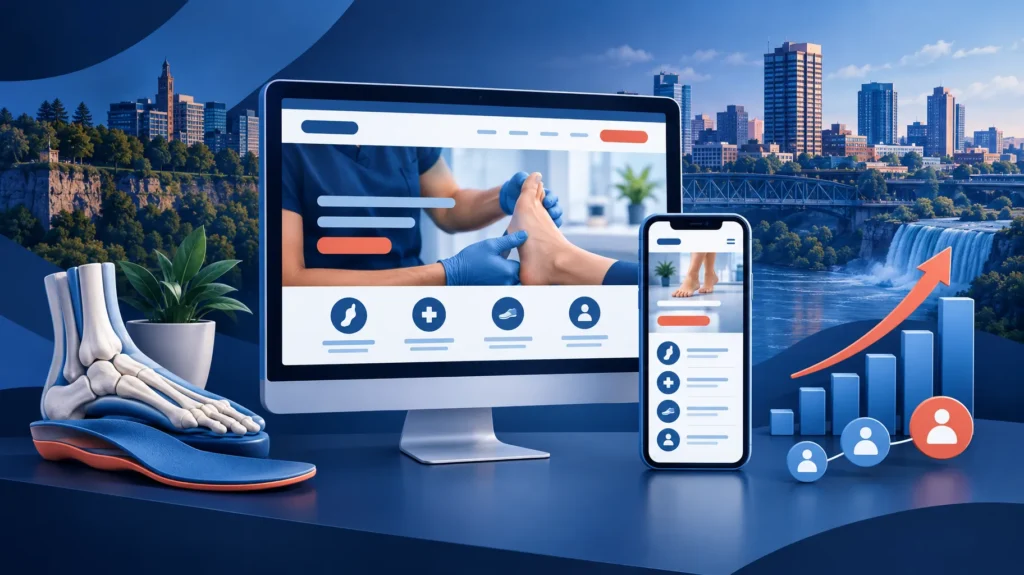
Chiropodist web design in Hamilton should do more than display a clinic logo, list services and provide a phone number. It should help a prospective patient understand whether your clinic treats their condition, trust your team, find your location, and book or call without friction.
For a Hamilton chiropody or podiatry clinic, the strongest website combines clear treatment information, practitioner credibility, mobile-friendly booking paths and local search fundamentals. A well-planned site can support patients searching from Hamilton Mountain, Ancaster, Dundas, Stoney Creek, Waterdown or nearby communities, without relying on generic health-care copy or an attractive design alone.
This guide explains the structure, content and local SEO decisions that matter when planning a chiropodist web design Hamilton project.
How Hamilton patients choose a chiropody clinic online
Most prospective patients arrive with a specific concern, such as heel pain, an ingrown toenail, a diabetic foot issue, a wart, a sports injury or difficulty walking. They are often comparing several local options quickly on a phone.
Before contacting a clinic, they typically want answers to five questions:
- Does this clinic treat my condition?
- Is the clinic close enough and easy to reach?
- Can I trust the practitioner?
- What should I expect during an appointment?
- Can I book or speak with someone easily?
Your website should answer those questions in that order. A homepage that only says “complete foot care” creates unnecessary uncertainty. A stronger page immediately explains who the clinic helps, which services are available, where the clinic is located and what the next step should be.
That is also why industry-specific planning matters. The approach used for a general GTA business website should be adapted for health-care decisions, patient privacy, accessibility and appointment conversion.
What should a chiropodist website homepage include?
A chiropody homepage should build confidence within seconds, then guide visitors toward a relevant service page or booking action. The homepage does not need to explain every treatment in detail, but it should make the clinic’s offer and next step unmistakable.
An original homepage wireframe for a Hamilton foot clinic
- Header: Clinic name, main navigation, phone number and a prominent “Book an Appointment” button.
- Opening section: A plain-language statement such as “Professional foot care for Hamilton patients,” supported by a short explanation of the conditions treated.
- Primary actions: “Book an Appointment,” “Call the Clinic” and, where appropriate, “View Services.”
- Trust panel: Practitioner credentials, years in practice if verified, professional memberships and a concise clinic introduction.
- Condition shortcuts: Links to pages for common concerns such as ingrown toenails, diabetic foot care, orthotics, corns, calluses and heel pain.
- What to expect: A three-step explanation covering assessment, treatment recommendations and follow-up.
- Location section: Hamilton address, parking or transit information, hours and an embedded map where useful.
- Patient feedback: Genuine reviews or a link to the clinic’s review profile, presented without editing the meaning of patient comments.
- Final booking section: A direct invitation to schedule an assessment or contact the clinic with a question.
The first screen should not be crowded with every service, badge or promotional message. Patients need a clear decision path. The rest of the page can provide supporting detail for visitors who are still researching.
Services, conditions and practitioner pages that support patient decisions
One general “Services” page is rarely enough for a clinic that treats different foot and lower-limb concerns. Individual pages allow patients to find relevant information and allow search engines to understand the relationship between the clinic, its treatments and Hamilton service area.
Useful chiropody service pages
- General chiropody assessments
- Ingrown toenail treatment
- Diabetic foot assessments and care
- Custom orthotics, if offered
- Corns and calluses
- Plantar warts
- Heel pain and related foot conditions
- Sports and activity-related foot concerns
- Routine foot care for seniors, if offered
Only create pages for services the clinic actually provides. Each page should explain who the service is for, common symptoms, what an appointment may involve, relevant preparation, fees or insurance information where available, and how to arrange an assessment. Avoid diagnosing visitors or suggesting that every symptom has one cause.
Practitioner and clinic pages
A practitioner page should go beyond a list of qualifications. It can explain the clinician’s approach, areas of interest, professional training and the types of patients they commonly support. Credentials should be accurate and easy to verify.
A separate “About” page can explain the clinic’s philosophy, accessibility, team and Hamilton location. Patients want to know whether the practice feels appropriate for their needs before they make contact, particularly when they are seeking care for a sensitive or painful problem.
For additional planning ideas, compare the patient journey in our guides to physiotherapy web design in Hamilton and chiropractor website design. The clinical services differ, but the principles of trust, clear navigation and low-friction booking are transferable.
Online booking and mobile conversion paths
A large share of local service research happens on mobile devices. A chiropody website should therefore be designed around thumb-friendly actions, readable content and a booking process that does not force visitors to search for the next step.
A practical booking flow
- The visitor selects “Book an Appointment” from the header or a service page.
- The booking page explains appointment types, expected duration and any information the patient should prepare.
- The visitor selects a suitable appointment or submits a request form.
- The clinic confirms the appointment and provides directions, policies and preparation details.
If online scheduling is not suitable for every appointment type, use a hybrid approach. Offer online booking for straightforward visits and a visible phone or enquiry option for complex cases. A form should ask only for information needed to respond. Avoid requesting detailed medical information through an insecure or unnecessary form.
Every important page should include a consistent conversion path. A service page might use “Book an assessment,” while the contact page might use “Call the Hamilton clinic.” Specific labels are more helpful than vague buttons such as “Submit” or “Learn more.”
Reviews, bios and credibility signals
Health-care websites need a careful balance between reassurance and restraint. Reviews, team information and transparent policies can reduce uncertainty, but credibility signals must be genuine and current.
- Display the practitioner’s verified credentials and professional designation.
- Explain the clinic’s approach in plain language.
- Use real team photographs when appropriate and keep them current.
- Link to the clinic’s Google Business Profile or review source where practical.
- Publish authentic patient reviews without changing their meaning.
- Explain appointment types, payment methods, insurance documentation and cancellation policies.
- Include a clear privacy statement and contact information.
Do not claim that a clinic is the “best” in Hamilton unless that statement can be supported and is appropriate. Do not publish invented testimonials or imply guaranteed treatment results. Trust is strengthened by accurate information, not exaggerated promises.
A related local service-business example is Milton Physio Rehab. It is not a chiropody project, but it demonstrates a transferable principle: a health-care website should make the service, clinic context and next action easy to understand before a visitor has to search through multiple pages.
Hamilton local SEO and Google Business Profile
A chiropody clinic needs local SEO because patients commonly search for a provider near where they live, work or attend appointments. Local visibility depends on more than repeating “Hamilton” throughout a page.
Start with an accurate Google Business Profile. Google’s official Business Profile guidance explains the importance of accurate business information, including the name, address, phone number, hours and category. Keep those details consistent with the website and other reputable listings.
The website should reinforce the local connection through useful information:
- A dedicated location or contact page with the complete Hamilton address.
- Service pages that naturally explain the clinic’s Hamilton service area.
- Driving, parking, transit and accessibility instructions where relevant.
- Embedded map information that supports, rather than replaces, written directions.
- Consistent clinic name, address and phone details.
- Internal links between the homepage, service pages, practitioner page and contact page.
Do not create thin pages for every Hamilton neighbourhood. Mention Ancaster, Dundas, Stoney Creek, Hamilton Mountain, Waterdown or Binbrook only when the clinic genuinely serves patients there or the information helps with directions and service-area clarity.
For a broader framework covering website structure, on-page content and local search, see our guide to web design and SEO in Hamilton. A chiropody site should apply those principles to real patient questions rather than treating local SEO as a list of place names.
Accessibility, privacy and performance
Foot clinics serve people with different ages, abilities, mobility levels and device preferences. Accessibility is therefore part of practical patient service, not just a technical add-on.
Use readable text, strong colour contrast, descriptive link labels, keyboard-friendly navigation, visible focus states and meaningful alternative text for informative images. The Web Content Accessibility Guidelines provide an established technical reference for planning accessible websites.
Performance also affects usability. Compress large images, avoid unnecessary animation, reduce third-party scripts and test the booking flow on a real phone. A fast homepage is useful, but the booking, contact and service pages must also load reliably.
Privacy deserves special attention for medical and appointment enquiries. Collect the minimum information required, explain how enquiry data is handled and use secure tools for booking and forms. The Office of the Privacy Commissioner of Canada provides guidance for organizations handling personal information. A web designer should coordinate with the clinic’s privacy and booking-system requirements rather than treating website forms as a one-size-fits-all solution.
Example Hamilton chiropody sitemap
A practical sitemap for a small or mid-sized foot clinic could look like this:
- Home
- About the Clinic
- Our Chiropodist or Practitioners
- Services
- Ingrown Toenail Treatment
- Diabetic Foot Care
- Custom Orthotics
- Heel Pain and Foot Conditions
- Fees and Insurance
- What to Expect
- Patient Resources or FAQs
- Contact and Location
- Book an Appointment
The exact sitemap should reflect the clinic’s services, staff and booking model. A smaller clinic may combine some pages, while a multi-practitioner practice may need separate practitioner, location or treatment pages.
This structure also makes future content easier. A patient resource about choosing footwear can link to relevant treatment pages, while a service page can link directly to booking and practitioner information.
How much does chiropody web design cost in Hamilton?
There is no single price for chiropodist web design in Hamilton. Cost depends on the number of pages, custom design requirements, copywriting, photography, booking integration, technical maintenance, accessibility work and local SEO scope.
A basic brochure website with a small number of carefully planned pages will cost less than a custom clinic website with condition-specific content, online scheduling, practitioner profiles and ongoing SEO. The right question is not simply “How many pages are included?” but “Does the website cover the questions that lead to an appointment?”
Our Hamilton web design cost guide explains the main pricing variables. Ask for a scope that identifies the pages, integrations, content responsibilities, launch support and ongoing services rather than accepting an unclear package.
How can a Hamilton chiropody website generate more leads?
A Hamilton chiropody website can generate more enquiries by matching each patient concern with a clear service page, strong trust information and a simple booking or call path. Lead generation is usually the result of many small improvements working together.
- Make the clinic’s services obvious on the homepage.
- Create useful pages for the conditions patients actually ask about.
- Place booking and phone actions in consistent locations.
- Show the practitioner’s credentials and approach.
- Improve local search signals and Business Profile accuracy.
- Make the site fast, accessible and easy to use on mobile.
- Track calls, form submissions and bookings where the technology and privacy setup allow it.
These improvements should support genuine patient decisions. No website can guarantee rankings, appointment volume or a particular return on investment, but a clearer experience gives local visitors fewer reasons to leave before contacting the clinic.
Does a chiropody business in Hamilton need local SEO?
Yes, local SEO is important for most Hamilton chiropody businesses because the service is location-dependent and patients usually need a clinic they can realistically visit. Local SEO includes accurate business information, relevant service content, a well-structured website, genuine reviews and a properly maintained Google Business Profile.
It should be treated as an ongoing business function, not a one-time paragraph added to the footer. Our Hamilton SEO services page provides more information about the broader process, while the website itself should remain useful to patients first.
Final checklist before launching a chiropody website
- The homepage clearly identifies the clinic, services and Hamilton location.
- Patients can book or call from every important page.
- Service and condition pages contain accurate, useful explanations.
- Practitioner credentials and clinic information are verified.
- Address, phone number, hours and directions are consistent.
- Forms and booking tools collect information securely and appropriately.
- The website works on current mobile devices and supports accessible navigation.
- Images are compressed and contain descriptive alternative text where needed.
- Google Business Profile details match the website.
- Analytics or enquiry tracking is configured with appropriate privacy practices.
Own a chiropody or podiatry business in Hamilton?
WebDesignGTA.com can help you plan a patient-focused website around your services, clinic location, booking process and local search goals. Get a tailored website and local SEO plan from WebDesignGTA.com.
Frequently asked questions
How much does chiropody or podiatry web design cost in Hamilton?
The cost depends on scope. A small informational site costs less than a custom clinic website with multiple treatment pages, professional content, online booking, accessibility improvements and ongoing SEO. Request an itemized proposal that explains page count, integrations, content, launch support and maintenance. The Hamilton web design pricing guide covers the main variables.
What pages should a chiropody or podiatry website have?
Most clinics need a homepage, About page, practitioner page, services or conditions pages, booking page, contact and location page, fees or insurance information, and patient FAQs or resources. The final sitemap should reflect the treatments the clinic actually provides and the questions patients ask before booking.
How can a Hamilton chiropody or podiatry website generate more leads?
Use clear service pages, visible booking and phone actions, accurate local information, genuine reviews, practitioner credentials and a fast mobile experience. Each page should help a visitor decide whether the clinic is appropriate and provide an obvious next step.
Does a chiropody or podiatry business in Hamilton need local SEO?
Yes. Local SEO helps connect a location-based clinic with people searching for relevant foot-care services nearby. It includes a complete Google Business Profile, consistent contact information, useful Hamilton-focused service content, strong website structure and genuine customer feedback. It does not guarantee rankings, but it improves the clarity and discoverability of the clinic’s online presence.