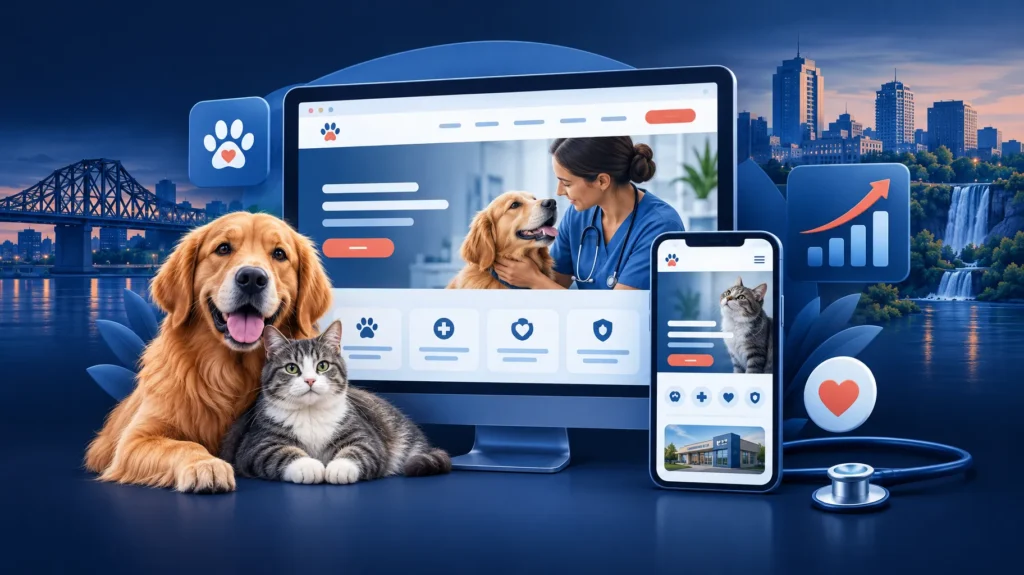
A veterinary clinic website has a short window to answer a prospective client’s most important questions: Can I trust this team? Do they treat my kind of pet? Are they close enough? Can I book or call without searching around? For clinics serving Hamilton, Ontario, veterinary web design should make those answers clear before a first visit.
A strong veterinary website combines reassuring content, practical mobile journeys, local search visibility, accessible design and prominent booking or call options. It should help a pet owner in Ancaster, Dundas, Stoney Creek, Hamilton Mountain or Waterdown understand the clinic’s services and take the next step with confidence. The following framework shows how to build that experience.
How Hamilton pet owners choose a veterinary clinic online
Most prospective clients are not judging a veterinary website as designers. They are trying to solve an immediate problem. Their dog may need an appointment, their cat may be due for a vaccine, or they may be looking for a clinic that treats rabbits or other small animals. The website must reduce uncertainty quickly.
Within the first few seconds, a visitor should be able to identify:
- Where the clinic is located and which Hamilton communities it serves
- What types of pets and services the clinic supports
- Whether new patients are welcome
- How to book an appointment or speak with the team
- Why the clinic is a credible choice
This is why veterinary website design in Hamilton should be planned around real decisions, not simply a collection of attractive pages. A polished design is valuable, but the website also needs clear information architecture, useful local content and conversion paths that work on a phone.
For broader planning principles, our guide to small business web design in Hamilton explains how local businesses can structure essential pages around customer questions.
What should a veterinary clinic homepage include?
The homepage should reassure visitors, explain the clinic’s services and direct them towards booking or calling. It should not force someone to scroll through a long introduction before finding practical information.
A veterinary clinic homepage wireframe
- Header: Clinic logo, phone number, address or service area, navigation and a visible “Book an Appointment” button.
- Opening section: A clear statement about veterinary care, the Hamilton location and the clinic’s approach, supported by a primary booking or call-to-action button.
- Urgent-care guidance: A concise explanation of what to do for emergencies, including whether the clinic provides urgent appointments or directs clients elsewhere.
- Core services: Links to preventive care, examinations, dentistry, surgery, diagnostics, vaccinations and other relevant services.
- Trust section: Team photographs, veterinarian credentials, client reviews and a short explanation of the clinic’s care philosophy.
- Pet types: Clear links for dogs, cats and any other animals regularly treated by the practice.
- Location and hours: Address, parking information, opening hours, service area and a map link.
- Final conversion section: A repeated booking button, phone number and a simple next step for new clients.
The page should use warm, professional photography or carefully selected imagery rather than generic stock photos that do not reflect the clinic. Real images of the reception area, treatment spaces and care team can help a visitor understand what to expect before arriving.
If a clinic needs a wider website strategy, the Hamilton web design service from WebDesignGTA.com can be used to plan the structure, content, design and technical build together rather than treating the website as a one-page brochure.
Services, conditions and practitioner pages that answer real questions
A veterinary website should make important services easy to find from search engines and from the main navigation. A single “Services” page may be suitable for a very small practice, but separate pages are often more useful when clients need detailed information before booking.
Service pages
Useful service pages may include wellness examinations, vaccinations, parasite prevention, dental care, surgery, diagnostic imaging, laboratory testing, nutrition counselling, senior pet care and microchipping. Each page should explain what the service involves, which pets may need it and what a client should do next.
Do not make clinical claims that the practice cannot support. The content should accurately reflect the clinic’s qualifications, equipment, availability and referral arrangements. It should also explain when a situation may require emergency care instead of a routine appointment.
Condition and question pages
Pet owners often search by concern rather than by service. Pages addressing topics such as itchy skin, vomiting, dental pain, arthritis, weight management or frequent urination can be helpful when they are written by or reviewed for clinical accuracy. These pages should educate without attempting to diagnose an individual animal online.
Veterinarian and team pages
Team bios are important trust pages. A useful profile can include professional credentials, areas of interest, languages spoken, approach to client communication and a human detail that helps the visitor feel comfortable. Use real photographs and keep information current.
For comparison, our article on medical clinic website design in Hamilton covers similar trust and information needs in a healthcare setting, while the veterinary site must add pet-specific services, species information and owner reassurance.
Online booking and mobile conversion paths
Many veterinary website visits happen when a pet owner is away from a desktop computer. The phone number, booking button and directions should therefore remain easy to find on a small screen. Buttons need enough space to tap, text must remain readable and forms should not ask for unnecessary information.
A practical booking flow
- Choose an action: The visitor selects “Book an Appointment,” “Call the Clinic” or an urgent-care information option.
- Identify the visit: The booking process asks whether the appointment is for a new or existing client, the type of pet and the general reason for the visit.
- Choose a time: Available appointment types and times are presented clearly, with realistic expectations about confirmation.
- Provide contact details: The form collects only the information required to arrange the appointment.
- Confirm the next step: The visitor receives a clear confirmation message explaining whether the booking is final or subject to clinic approval.
Not every clinic needs the same booking technology. A practice may use an integrated scheduling platform, a request form, email, telephone or a combination. The important point is to avoid creating a misleading “instant booking” experience if staff still need to confirm the request.
Keep the phone number visible in the mobile header and repeat it near appointment-related content. A visitor who cannot find the booking tool should not have to return to the homepage or search the footer.
Reviews, bios and other credibility signals
Trust is central to veterinary marketing because clients are choosing someone to care for a member of their family. A clinic website can build credibility by making evidence easy to verify and by setting honest expectations.
- Display recent client feedback in a readable format, with a link to the clinic’s public review profile where appropriate.
- Show the veterinarians and support team by name and photograph.
- Explain appointment preparation, payment expectations and follow-up processes.
- Identify professional memberships, qualifications or certifications accurately.
- Show the clinic environment, equipment and accessibility details where relevant.
- Include a transparent contact page with address, hours and directions.
Reviews should never be presented in a way that suggests every pet will have the same outcome. They work best alongside detailed service information and a genuine explanation of how the practice cares for patients and communicates with owners.
A related local service-business example is the Bark & Brush Pet Spa website project. Although a pet spa is not a veterinary clinic, its transferable lesson is that pet owners respond to a clear service presentation, friendly visual language and an easy path to take the next step.
Hamilton local SEO and Google Business Profile
Yes, a veterinary business in Hamilton needs local SEO if it wants nearby pet owners to discover the clinic through search. Local SEO does not guarantee rankings, but it helps search engines and prospective clients understand the clinic’s location, services and relevance.
The website should use the clinic’s real business name, address, phone number, hours and service information consistently. Location details should appear naturally on the contact page, homepage and other pages where they help visitors. A clinic can mention relevant areas such as Hamilton Mountain, Ancaster, Dundas, Stoney Creek or Waterdown when those communities are genuinely part of its service area. Repeating neighbourhood names without useful context makes the page harder to read.
The clinic should also claim and maintain its Google Business Profile. Keep the category, hours, phone number, website, photos and services accurate. Respond to reviews professionally and update holiday hours when necessary. Google’s own guidance explains that businesses should represent themselves accurately and keep profile information current.
On the website, local relevance can be strengthened through:
- A dedicated contact and location page with parking, transit and arrival instructions
- Service pages that identify the Hamilton clinic without forced repetition
- Helpful answers for new clients, including what to bring to an appointment
- Accurate structured business information and consistent contact details
- Fast, mobile-friendly pages that make it easy to call or request an appointment
Our guide to web design and local SEO in Hamilton provides more detail on connecting website structure with local lead generation. Veterinary practices that need ongoing search strategy can also review Hamilton SEO services.
Accessibility, privacy and performance
A veterinary website should be usable by people with different abilities, devices and levels of digital confidence. Accessibility improvements also tend to make the experience clearer for everyone.
- Use sufficient colour contrast and readable font sizes.
- Add meaningful alternative text to informative images.
- Make keyboard navigation and form labels clear.
- Do not rely on colour alone to communicate errors or appointment status.
- Provide descriptive headings and link text.
- Keep important information available without requiring a video or animation.
Review the clinic’s forms and booking tools for privacy. Collect only the information needed for the requested interaction, explain how submissions are handled and use secure connections. A privacy policy should accurately describe the website’s data practices rather than copying generic legal text that does not match the clinic.
Performance matters because large images, unnecessary scripts and poorly configured booking tools can make a mobile page frustrating to use. Compress images, choose hosting and plugins carefully, and test the real booking path on current phones. A fast website is not a substitute for good content, but a slow or unstable one can prevent a visitor from reaching that content.
Example Hamilton veterinary sitemap
The following page map is a practical starting point for a small or mid-sized clinic:
- Home
- About the Clinic
- Our Veterinarians and Team
- Services
- Wellness and Preventive Care
- Dental Care
- Surgery and Diagnostics
- Pet Types or Species
- New Clients
- Resources and FAQs
- Contact and Location
- Book an Appointment
- Privacy Policy
The final structure should reflect the clinic’s actual services. A practice that does not offer surgery should not create a surgery page simply to target a keyword. Similarly, a clinic serving only dogs and cats should not imply that it treats exotic species.
How much does veterinary web design cost in Hamilton?
Veterinary web design costs in Hamilton depend on the number of pages, content requirements, booking integrations, photography, technical complexity, SEO support and ongoing maintenance. A basic brochure website generally costs less than a custom clinic website with detailed service pages, practitioner profiles, booking workflows and local search preparation.
Budget for more than visual design alone. Professional copywriting, accurate clinical review, photography, accessibility checks, hosting, maintenance and appointment software integration can affect the total project cost. The right comparison is not simply the lowest initial quote. It is whether the website will accurately represent the practice and make it easier for the right local clients to contact the clinic.
For a broader Canadian and Hamilton-specific planning reference, see our web design cost guide for Hamilton. Pricing should be confirmed through a project scope because each veterinary practice has different requirements.
How can a Hamilton veterinary website generate more leads?
A Hamilton veterinary website can generate more enquiries by combining clear local positioning, prominent calls to action, useful service content, trust signals and a friction-free mobile experience. Start with one primary action, such as booking an appointment, and make secondary actions such as calling the clinic easy to find.
Measure meaningful actions rather than vanity metrics. Depending on the setup, useful measures may include completed booking requests, phone enquiries, contact-form submissions, directions requests and visits to important service pages. Review those actions regularly and improve pages where visitors are dropping out.
A website should support the clinic’s reception team, not create confusion for them. Use consistent appointment language, explain response times and make urgent-care instructions prominent. When a visitor knows what will happen after submitting a request, they are more likely to take that step.
Final checklist for a veterinary website redesign
- Can a new client find the clinic’s Hamilton location and phone number immediately?
- Is the booking or contact action visible on mobile?
- Are services organised around the questions pet owners actually ask?
- Do team bios and photographs make the clinic feel credible and approachable?
- Are reviews presented accurately and responsibly?
- Does the Google Business Profile match the website?
- Are urgent-care instructions clear and current?
- Are forms accessible, privacy-conscious and easy to complete?
- Do pages load quickly on a typical mobile connection?
- Does every major page give the visitor a relevant next step?
Frequently asked questions
How much does veterinary web design cost in Hamilton?
The cost varies with the website’s size, content, booking requirements, photography, SEO scope and maintenance needs. A simple informational site costs less than a custom website with multiple service pages, team profiles, booking integration and ongoing local SEO. A written project scope is the best way to receive an accurate CAD estimate.
What pages should a veterinary website have?
Most veterinary websites need a homepage, services, veterinarian and team profiles, new-client information, pet or species information, contact and location details, booking access, resources or FAQs and a privacy policy. The exact sitemap should match the clinic’s real services and the questions clients ask before booking.
How can a Hamilton veterinary website generate more leads?
Use clear calls to action, prominent phone and booking options, locally relevant service pages, credible team information, accurate reviews and a fast mobile experience. Track booking requests, calls and contact submissions so the clinic can improve the pages and processes that influence enquiries.
Does a veterinary business in Hamilton need local SEO?
Local SEO is valuable because veterinary care is location-dependent. Accurate website contact details, useful Hamilton service information, a well-maintained Google Business Profile and clear location pages help nearby pet owners understand where the clinic is and what it offers. Local SEO supports discovery but cannot guarantee a particular ranking position.
Build a veterinary website that earns trust before the first visit
For a Hamilton veterinary practice, the best website is not simply attractive. It makes the clinic’s services understandable, shows the people behind the care, answers practical questions and gives every visitor a clear next step. A focused website can support new-client enquiries while also reducing avoidable questions for the reception team.
Own a veterinary business in Hamilton? Get a tailored website and local SEO plan from WebDesignGTA.com.
Sources and fact-check references
- Google Business Profile guidelines, for accurate business representation and profile information.
- Google Search Central LocalBusiness structured data documentation, for local business information guidance.
- W3C Web Content Accessibility Guidelines, for accessibility principles and requirements.
- Office of the Privacy Commissioner of Canada privacy guidance for businesses, for privacy and personal-information considerations.